

In the world of risk management and business strategy, two terms that often appear are Key Risk Indicator (KRI) and Key Performance Indicator (KPI). Although they sound similar, they have different functions and purposes. Understanding these differences is critical for organizations that want to manage risk while improving performance on an ongoing basis.
This article will discuss in full about the meaning, purpose, examples, and comparison between KRI and KPI.
What is a Key Risk Indicator (KRI)?
Key Risk indicators are metrics used to provide early warning of potential risks that may affect the achievement of organizational goals. KRI serves as an alert system that helps management identify and respond to risks before they negatively impact business operations.
KRI is designed to measure the level of risk exposure in various aspects of business, ranging from operational risk, financial, compliance, to strategic risk. By monitoring the KRI periodically, the company can take timely preventive measures to mitigate possible risks.
The main characteristics of KRI include the ability to provide early indications of changes in the risk profile, easily understood by stakeholders, objectively measurable, and relevant to the organization's business objectives. An effective KRI must be sensitive to changes in the risk environment and be able to trigger an appropriate management response.
Primary Purpose of Key Risk Indicators
The implementation of KRI in organizations has several very important strategic objectives. The first goal is to provide early warning of potential problems before they develop into a crisis that could harm the organization. With this early warning system, management can take more effective preventive measures.
The second goal is to assist in a more informed decision-making process. KRI provides objective data and information about current risk conditions, so that management can make decisions based on facts and accurate analysis.
KRI also aims to improve the overall effectiveness of risk management. By monitoring key indicators, organizations can allocate resources for risk mitigation more efficiently and on target.
In addition, KRI assists in meeting regulatory and compliance requirements. Many industries have specific requirements regarding risk management, and the KRI can be evidence that the organization has adopted good risk management practices.
Example of Key Risk Indicator
Here are some examples of KRI commonly used in various sectors:
1. Financial Sector
- Non-performing loans (NPL)ratio: Measure the percentage of unpaid loans on time.
- Capital adequacy ratio (CAR): Demonstrate the bank's ability to absorb losses.
2. Manufacturing Sector
- Number of work accidents per month: Detect occupational safety risks.
- Engine damage rate: Assess the risks to the continuity of production.
3. Information Technology Sector
- Number of data security breaches: Cybersecurity risk indicators.
- Downtime sistem IT: Indicates operational vulnerability.
4. Retail Sector
- Product return ratio: Signifies potential quality or customer satisfaction issues.
- Number of customer complaints: Signals a risk to reputation.
KRI is dynamic and must be adapted to the changing business context and risk environment.
See also: Brand Trust strategies to increase customer loyalty
The Difference Between Key Risk Indicators and Key Performance Indicators
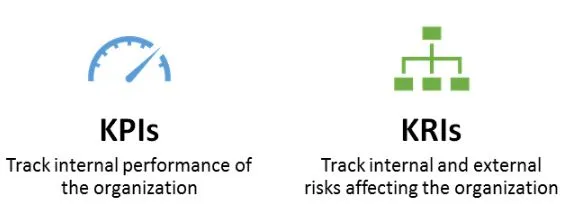
Although KRI and KPI both use metrics to assess certain aspects of business operations, they have fundamental differences. Here is a comparison table between KRI and KPI:
| Aspect | Key Risk Indicator (KRI) | Key Performance Indicator (KPI) |
| Focus | Risk (threat) | Performance (results) |
| Purpose | Detect potential risks | Measuring target achievement |
| Properties | Preventive | Evaluative |
| Time | Tend to see the potential for future events | Assess the outcome of past and present events |
| Example of | The number of cyber attacks, delays in the delivery of raw materials | Number of products sold, quarterly revenue |
| Benefit of | Assist in risk mitigation and preventive decision making | Drive efficiency, productivity and business growth |
How to effectively manage KRI and KPI
In order for KRI and KPI to bring maximum benefit, here are some best practices:
- Align with strategic goals: Choose indicators that are relevant and support the vision and mission of the organization.
- Use Valid and accurate Data: The validity of the data is critical to the accuracy of the analysis.
- Perform Periodic Reviews: Business conditions and risks can change, so indicators must be reviewed and adjusted regularly.
- Engage Stakeholders: Involve management, relevant departments, and even regulators if necessary.
- Use technology and Dashboard: Use an automated monitoring system to visualize KRI and KPI data in real-time.
Conclusion
Key Risk Indicator (KRI) and Key Performance Indicator (KPI) are two important tools in organizational management that serve to measure risk and performance. KRI helps organizations recognize potential risks before they have a major impact, while KPIs focus on achieving business results and targets.
Both cannot stand alone. Integration between KRI and KPI can create a management system that is balanced, resilient, and responsive to challenges and opportunities. For companies that want to remain competitive in the midst of global dynamics, understanding and implementing these two indicators precisely is a non-negotiable step.
Need help managing KRI and KPI in your company? Audithink ready to help you build an integrated and effective risk and performance management system. With a team of experienced experts in the field of audit, Risk Management, and compliance, we provide consulting services, training, and implementation of KRI and KPI tailored to your business needs. Immediately try application demo or contact the contact directly here!