
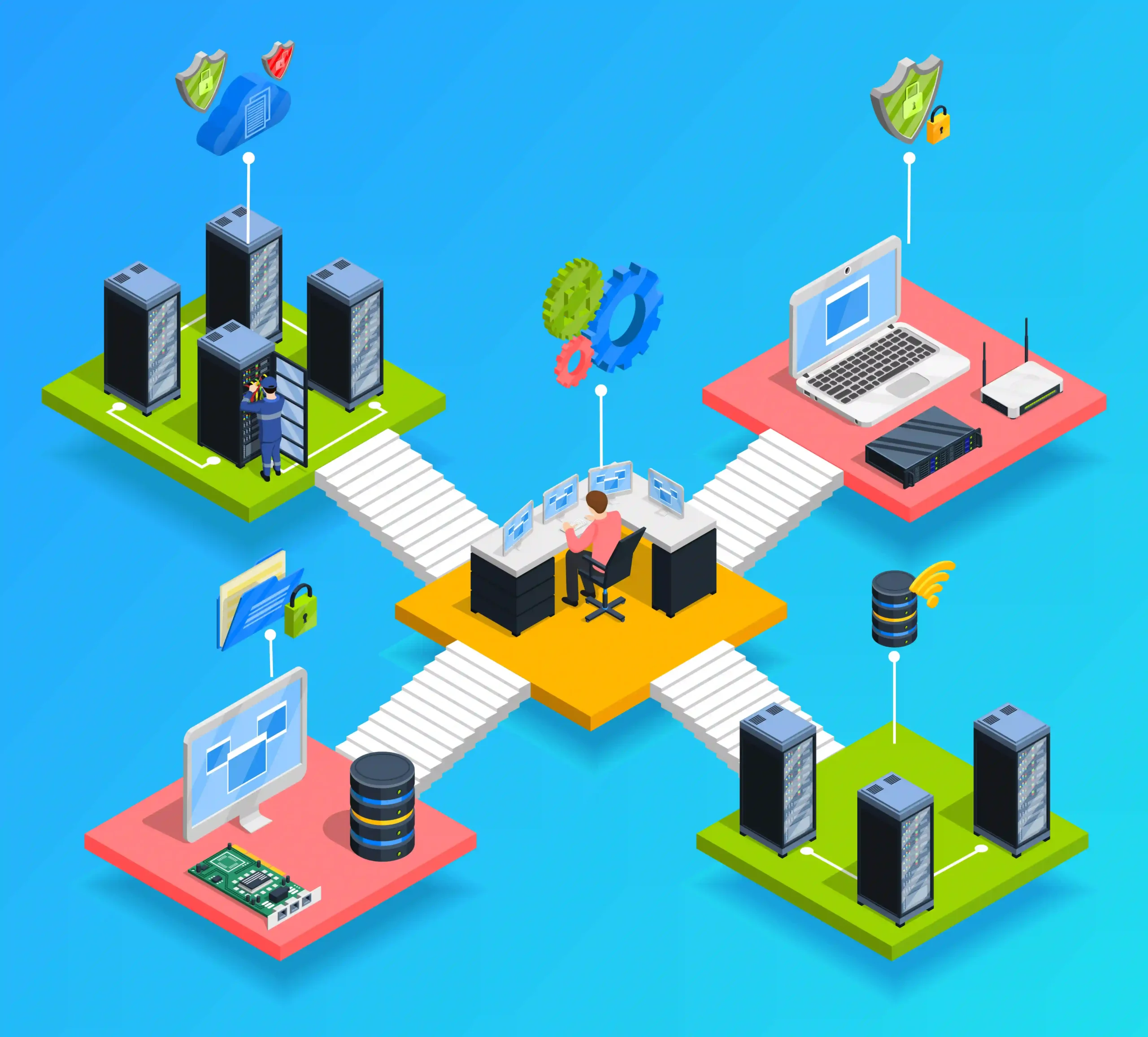
Each type of topology offers different network configurations, costs, advantages, and disadvantages that can be tailored to the needs of the user company or organization. This article will further explain the functions, types, and examples of topologies in everyday life.
What is Network Topology?
Network topology is the method used to connect computers to each other to form a network. Its purpose is to facilitate the exchange of data, information, and resources.
Furthermore, this method works by forming a network using UTP cables, fiber optics, and wireless connections. These components allow data to be sent across the network or computers.
Network Topology Functions
In general, network topology functions to regulate how devices connect to each other and how data flows efficiently, securely, and stably. Furthermore, topology also serves other functions, as follows.
- Determine the data communication flow – data is not sent randomly, but follows a certain structure. For example, via switch center or pass through several nodes first.
- Assist in network design and implementation – topology is the initial design guide so that the network is not built haphazardly, but is adapted to operational needs, efficiency, and future development plans.
- Make it easier maintenance and troubleshooting – the topology that forms the structure allows for faster identification of outages. Administrators can understand which nodes are experiencing problems and the impact of the outage on the network.
- Optimize efficiency and reduce collision – certain types of topology can reduce data collision (data collisions), allowing for more stable transmission, and increased communication speed.
- Managing cost efficiency – the implementation of the network topology indirectly determines how much cable is needed, what additional devices are needed, and whether a particular solution fits the budget or not.
Types of Network Topology
1. Bus Topology
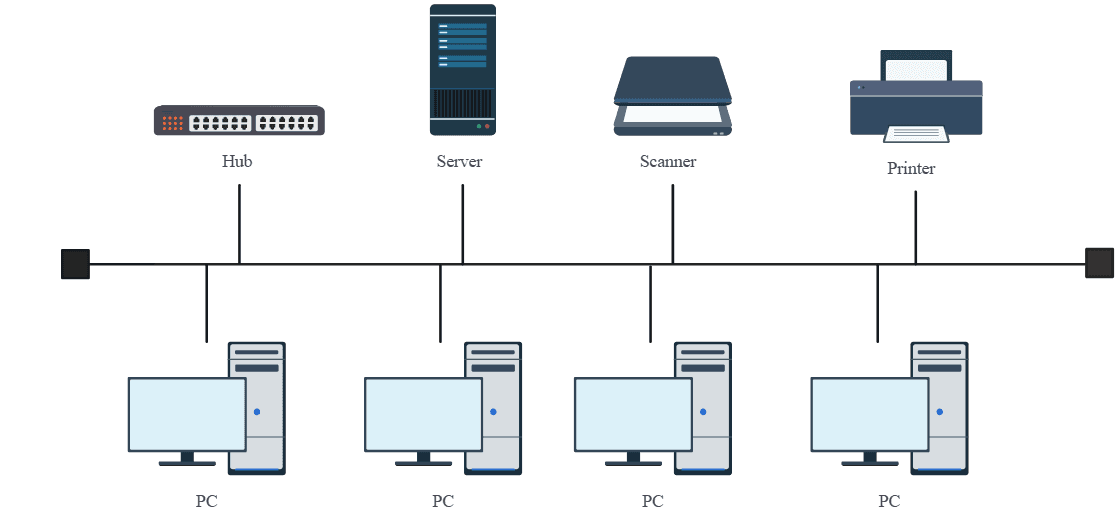
A bus topology is a network that connects all computers via a single main cable. Each device can send data through the cable, but the data is only received by the intended device.
This type of topology is easy to implement, suitable for small-scale networks, and has low installation costs. However, if the main cable is damaged, the entire network will be inoperable. The number of connected devices can also affect network performance.
2. Star Topology
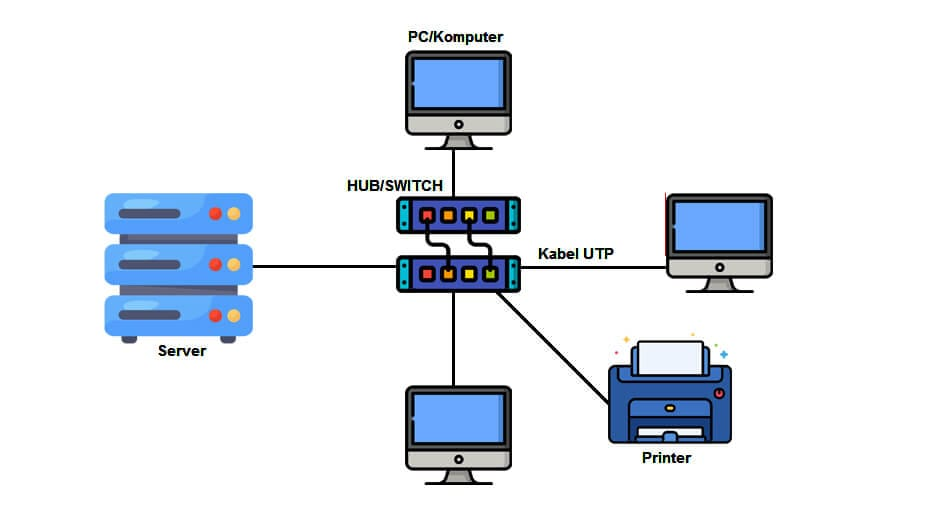
A star topology is a network that connects all devices to a central point. When data is sent, the central point acts as a transit point before it reaches its destination device. With this central point, damage to one of the connecting cables will not affect the entire network.
This type of topology also offers ease of configuration and maintenance. Network performance remains stable even with many connected devices. However, installation costs are higher than with a bus topology, and if the central node fails, the entire network will be inoperable.
3. Ring Topology
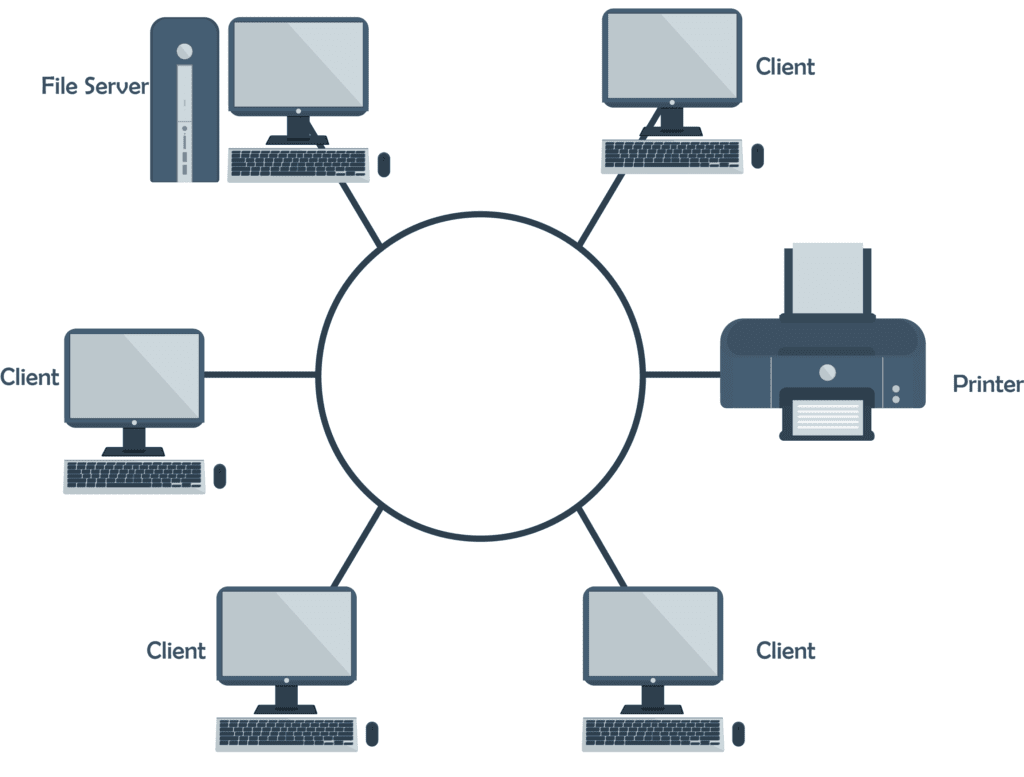
Another type of topology is the ring topology – a circular network that flows data regularly in one direction.
Similar to a bus topology, if a device or cable fails, the entire network can be disrupted. Furthermore, users may experience difficulties when adding new devices.
4. Mesh Topology
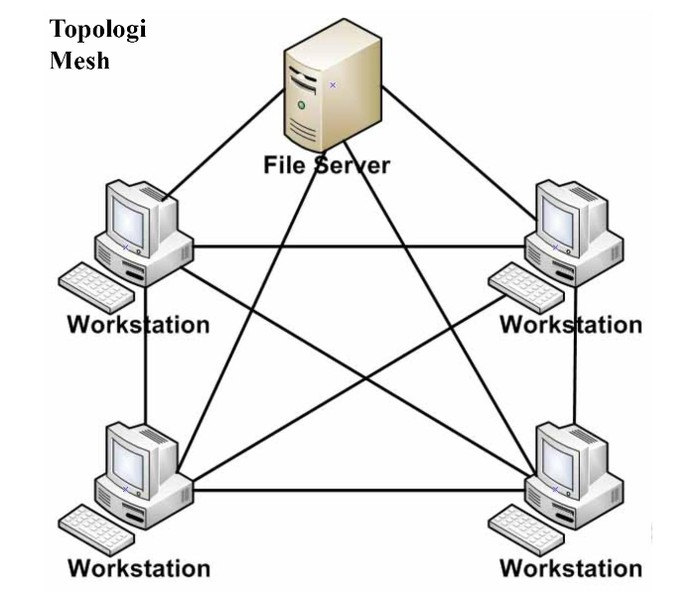
Topology mesh is a network that is capable of connecting each device to other devices. This type of topology has two types, namely full mesh, where the network connects to all devices directly and partial mesh, namely the network is connected to only some devices.
This type of topology is reliable for data transmission because it offers alternative paths. However, installation costs tend to be high and setup is complicated.
5. Tree Topology
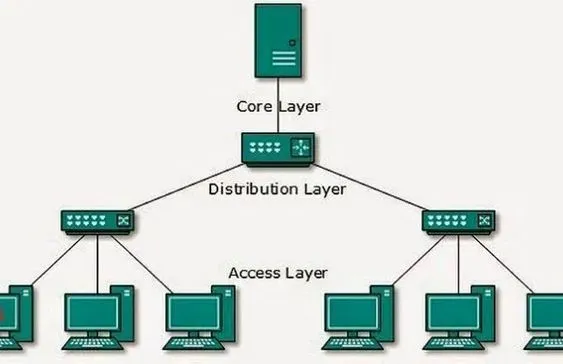
Topology tree is a combination of several topologies star connected in a tree or hierarchical structure. At each level of this network, there are several devices that act as central nodes.
Topology tree This is a type of topology that's easy to expand when a company wants to add new devices. However, if the main cable fails, the entire network will be disrupted.
Examples of Network Topology in Everyday Life
Examples of network topology applications can be found in your environment, some of which are as follows.
- Topology bus: a school computer lab that relies on one main cable to connect all the computers.
- Topology ring: an office computer network system that connects to two other computers on the left and right. Once popular for small companies, but is now rarely used.
- Topology star: Wi-Fi at home or in the office and all devices such as laptops, cell phones, and printers connected to it router center.
- Topology tree: a network of devices commonly used in universities. Generally, each faculty has its own server connected to a central server.
- Topology mesh: Wi-Fi system mesh in a large house or hotel, usually using a device router which are interconnected.
Advantages and Disadvantages of Network Topology
Overall, implementing a network topology can have the following advantages.
- Data communication efficiency – structured topology allows for more orderly data flow and minimal collisions.
- Ease of management – topology such as star and tree allows for easier problem detection and network development.
- Flexibility of use – topology such as hybrid allows network implementation to be tailored to needs, both in terms of cost and performance.
- High reliability – types of topology mesh provides ease of data delivery when one of the networks is damaged, because it provides many alternative routes.
- Low cost for small networks – small scale businesses can use this topology bus which offers low costs and a simple network.
In addition, network topology also has a number of disadvantages that are important for users to consider.
- Dependence on the center point – types of topology such as star and tree relies on a central point as a concentrator. When that central point is damaged, the entire network can potentially be disrupted.
- High costs and complexity – topology such as mesh and hybrid requires a lot of cabling and complicated configuration, so it tends to be more expensive to implement.
- Vulnerable to total disruption – a single cable failure can paralyze the entire network, as the system relies on a single main path. This is common in network topologies. bus and ring.
- Difficult to develop – some types of topology are less flexible for adding new devices, such as the topology ring and bus.
- Maintenance is more complicated – large topologies such as tree and mesh requires more complicated maintenance, because the connection structure is more complex, the number of devices is greater, and the communication path is not as simple as the topology. bus or star.
How to Choose the Right Network Topology?
Each type of network topology offers different advantages, disadvantages, network requirements, scalability, cost, and performance. To choose the right topology, consider the following points.
- Basic network requirements – includes the network objectives (for schools, small offices, or production systems), the devices that will be connected (such as computers, printers, and CCTV), the network coverage (one room, one building, or between buildings), and the data traffic capacity (such as browsing, email, or large data transfers).
- Scalability – users can ensure that the topology is easy to expand or expand when the number of employees or devices increases without changing the entire system.
- Budget – each type of topology offers different costs. Starting from cable costs, switch, router, installation, configuration, maintenance, up to upgrade future.
- Security and compliance – if the network topology will be used to handle customer personal data, financial, health, and confidential company information, then the network structure must be able to support access control, reduce the risk of leaks, and have redundancy so that data is not lost.
Conclusion
Each type of network topology offers different advantages and challenges. The more complex the topology, devices, and communication paths, the greater the potential for configuration errors, security vulnerabilities, or hidden intrusions.
Therefore, topology implementation also requires scheduled maintenance. One way to do this is through a systematic audit process to minimize downtime, data leaks, or undetected operational inefficiencies.
Use Audithink audit application to monitor, evaluate, and ensure your company network remains optimal, secure, and meets operational standards. Contact our team for collaboration or further consultation.