

In a world of audit there are things that are used by the auditor to ensure that all important aspects of a process have been thoroughly examined.
Checklist auditing is what it is. For a more complete explanation, let's look at the topic together Audithink discuss this time.
Definition of Audit Checklist
Checklist an audit is a list of questions or items compiled to guide the audit process in examining the conformity of operational, financial, or procedural practices to established standards.
Checklist it is used by auditors to ensure that all critical aspects of a process, system, or area being audited have been thoroughly examined, helping to identify potential problems, nonconformities, or areas that require improvement.
As well as internal audit checklist which can help internal auditors identify deficiencies, areas in need of improvement, as well as ensure regulatory compliance and operational efficiency.
To ensure that internal audit implemented efficiently, auditors should make various preparations, one of which is to prepare a checklist for internal audit.
Although in the ISO 9001: 2015 standard there is no detailed description of the obligation to make an internal audit checklist, but still recommend to clients to draw up checklist such. This is due to the many benefits that can be obtained by checklist in the internal audit process.
Benefits Of Internal Audit Checklist
After understanding the definition at a glance, the following are some of the benefits of using checklist in the implementation of internal audit.
1. Helps To Remember
One of the main advantages of using a checklist is that it helps auditors remember the questions that need to be asked to Auditee.
In the internal audit process, the Auditor will examine various processes, activities, and procedures within the organization, so there will be many questions that need to be asked to the Auditee.
By recording these questions into checklist before the day of the audit, the Auditor can look more prepared in the presence of the Auditee.
2. Guarantee covers all checked points
In addition to helping to remember, checklist it also serves to ensure that all requirements or clauses of ISO 9001: 2015 relevant to the Auditee have been examined by the Auditor. Accuracy and caution in drawing up checklist highly preferred for checklist this includes all requirements relating to the Auditee.
3. Ensure that interactions between processes are covered
In a process, it often involves several departments in the organization. For example, in the process of procurement of goods and services, could involve the Department of filing, purchasing, finance, directors, to the warehouse.
Checklist this gives the Auditor a view of the interactions between those processes, so the Auditor needs to study the procedures to be audited and record the points where there are interactions with other departments.
4. Ensure Audit depth and continuity
Other advantages of using checklist is to make the examination more in-depth, rather than simply verifying there is or is not and yes or no. In checklist, The Auditor can draw up more detailed questions related to the requirements to be examined. Examples are as follows:
- Has a quality Policy been established?
- Is the quality policy in accordance with the requirements of the ISO 9001:2015 standard, clause 5.2.1? Note: there must be a commitment to meet applicable requirements and a statement of continuous improvement on the quality management system.
- Has the quality Policy been disseminated to all employees? How is it socialized? Note: Take a sample of several people and ask about the company's quality policy.
- Is the quality policy evaluated regularly?
The examples above show the questions in the checklist related to quality policy. Checklists can help auditors to maintain the depth of audit questions.
Of course, the Auditor's thoroughness when compiling the checklist is very important.
Example of Checklist Internal Audit
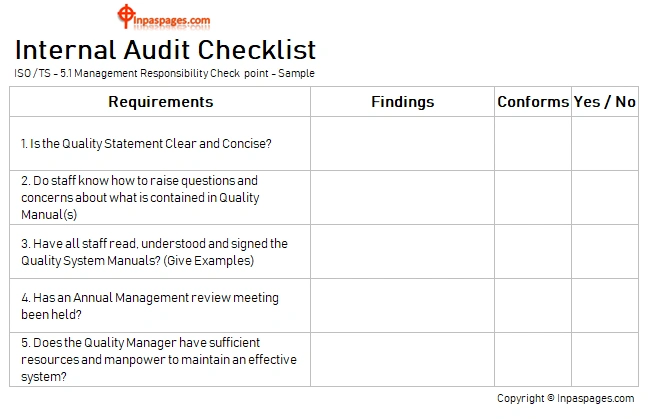
Checklist an internal audit is a list of inspection points that an internal auditor uses to ensure that every aspect of a company's operations is running in accordance with applicable standards, policies, and regulations.
With checklist this, the company can conduct a thorough evaluation of its business processes and make the necessary corrective actions.
Here is an example checklist internal audit as follows.
1. Compliance With Company Policy
Example of checklist this first internal audit verifies whether the company's internal policies have been implemented and adhered to by all employees, as well as whether the policies have been updated as needed by the company. Here is the list of questions.
- Are all company policies clearly documented?
- Do employees understand and follow the policy?
2. Risk Management
Example of checklist this second internal audit evaluates the extent to which the company has identified and managed potentially adverse risks, as well as ensuring a clear mitigation plan is in place. Here is the list of questions.
- Has the company identified the main risks?
- Are risk mitigation measures effective?
3. Operational Process
Example of checklist this third internal audit aims to ensure that all operational processes are running according to standards, look for inefficiencies, and identify opportunities to improve work efficiency. Here is the list of questions.
- Is every step of the operational process in accordance with the established standards?
- Are there any steps that can be simplified?
4. Financial Control
Example of checklist this fourth internal audit aims to check whether the financial system has been working properly, record all transactions precisely and transparently, and comply with Accounting Reporting Standards. Here is the list of questions.
- Is the recording of transactions carried out accurately?
- Are financial reporting procedures in accordance with accounting standards?
5. Human Resources (HR)
Example of checklist this fifth internal audit examines compliance in managing HR, from recruitment to performance appraisal, ensuring that human resources are well managed to support the company's objectives. Here is a list of questions.
- Is the process of recruitment and training of employees carried out according to the policy?
- Is the performance appraisal system applied fairly?
6. Information Security

This section examines the extent to which an information security system is able to protect a company's critical data, both from internal and external threats. Here is a list of questions.
- Is the data security policy implemented and adhered to?
- Are the existing security systems adequate to protect sensitive information?
7. Regulatory Compliance
This section aims to ensure that the company complies with all applicable laws and regulations in its business sector, as well as documenting evidence of compliance. Here is a list of questions.
- Does the company comply with all applicable regulations?
- Is there any external audit which shows regulatory compliance?
8. Quality and Production Management
The focus of these audits is to ensure that the products produced meet quality standards, and that there are systems in place to deal with unqualified products. Here is a list of questions.
- Is there an effective quality control system?
- Are defective products treated according to procedures?
9. Environmental Health and safety (HSSE)
This Audit evaluates whether the company prioritizes employee health and safety through adherence to safety procedures as well as regular training. Here is a list of questions.
- Are work safety protocols consistently followed?
- Is there regular safety training?
10. Documentation and Archives
This check ensures that the company's documents are properly managed, from storage, to access, to archiving in accordance with established procedures. Here is a list of questions.
- Are all important documents kept safe?
- Is there a procedure for accessing and archiving documents?
The internal audit Checklist helps companies evaluate various aspects of their operations and compliance with policies and regulations.
Each point in the checklist provides a special focus on critical areas such as finance, HR, risk and information security, ensuring that all company functions run efficiently and according to established standards.
Read Also: Peran Penting CEO dalam Perusahaan
Conclusion
The use of this checklist ensures that the audit process runs in a structured and thorough manner, covering all critical points that must be examined.
With a well-planned checklist, companies can identify areas that require improvement, maintain operational efficiency, and ensure compliance with applicable standards and regulations.
Last but not least, we Audithink providing an application that will help the audit team of your company with a variety of features that we offer. The applications we offer are already trusted by many companies because the internal audit process is faster, accurate, and also motorized.
If you are interested in doing a trial or just consult more deeply, contact us for more complete information.