

An audit opinion is a formal statement issued by an auditor regarding the fairness of the presentation of an entity's financial statements, based on applicable auditing standards. This opinion is the final conclusion of the entire audit process and determines the extent to which the financial reports can be relied upon by stakeholders—from management, investors, regulators, to the public.
According to the currently applicable Auditing Standards, there are 4 types of audit opinion: unqualified opinion, qualified opinion, adverse opinion, and disclaimer of opinion. Some references mention five — the explanation for that difference is in the next section.
In Indonesia, audit opinion refers to Standard Audit (SA) published by the Indonesian Institute of Certified Public Accountants (IAPI), specifically SA 700–705, as well as the provisions of the Audit Board of the Republic of Indonesia (BPK) for government financial statements. This article discusses the meaning of audit opinion, the number and types of opinion under the standard, the stages of forming it, the factors that influence it, and examples of its application in both the corporate and public sectors.
How Many Audit Opinions Are There? 4 or 5?
This question is often confusing because the answer depends on which framework is used. The two are not contradictory — they simply belong to different generations of standards.
| Classic framework — 5 types | Current Auditing Standards — 4 types |
|---|---|
| 1. Unqualified opinion | 1. Unqualified opinion |
| 2. Unqualified opinion with explanatory language | Not a separate opinion type — now an emphasis-of-matter paragraph, without changing the unqualified opinion |
| 3. Qualified opinion | 2. Qualified opinion |
| 4. Adverse opinion | 3. Adverse opinion |
| 5. Not giving an opinion | 4. Disclaimer of opinion |
So the difference lies in just one point. The old framework treated “unqualified opinion with explanatory language” as a stand-alone fourth opinion type. The currently applicable standard no longer treats it as a separate opinion type: when the auditor needs to highlight a matter, they add an emphasis-of-matter paragraph to the report, while the opinion remains unqualified.
In short: following the applicable auditing standard, the answer is 4 types of audit opinions. The number 5 comes from the earlier framework still widely used in course materials, and its extra point is not a new opinion but a variation in how the unqualified opinion is presented.
Understanding Audit Opinion
An audit opinion is the auditor's professional conclusion on the fairness of the financial statements after conducting an audit in accordance with auditing standards. Fairness here does not mean that the statements are completely free from error, but rather that the financial statements are presented fairly in all material respects in accordance with the applicable financial reporting framework (e.g., SAK or SAP).
According to Public Accountant Professional Standards (SPAP), an audit opinion is a statement of opinion submitted by an independent auditor after collecting and evaluating audit evidence sufficient and appropriate. This opinion is stated in the independent auditor's report accompanying the financial statements.
It's important to understand that an audit opinion is not a guarantee that a company is financially sound or free from the risk of fraud. The opinion only assesses whether the financial statements fairly reflect the entity's condition and comply with accounting standards.
Function of Opinion Audit
Audit opinions have several main functions for both entities and external parties:
- Increase the credibility of financial reports. The opinion of the independent auditor provides assurance that the report has been examined objectively.
- The basis for stakeholder decision making. Investors, creditors, and regulators use audit opinions to assess the reliability of financial information before making decisions.
- Benchmark for governance improvement. An opinion other than Unqualified is a signal for management to improve the internal control and reporting system.
- Fulfillment of regulatory obligations. For public companies, state-owned enterprises, and government agencies, an audit opinion is a mandatory compliance requirement.
Stages of Forming an Audit Opinion
An audit opinion doesn't emerge instantly, but rather is the result of a systematic audit process. The main stages are as follows.
1. Audit Planning
Auditors develop strategies and audit plan, including understanding the client's business, assessing the risks of material misstatement, and determining materiality level. Careful planning determines the direction and scope of testing.
2. Understanding and Testing Internal Control
The auditor evaluates the effectiveness of the entity's internal controls. If the controls are deemed reliable, auditor can reduce substantive testing; if weak, testing is expanded.
3. Substantive Testing
At this stage the auditor gathers evidence through testing of account balances and transactions—confirmations, document inspections, recalculations, and analytical procedures—to detect material misstatements.
4. Evaluation of Evidence and Formulation of Opinions
The auditor evaluates the sufficiency and appropriateness of the audit evidence and then forms an opinion. The availability of evidence and the degree of material misstatement determine the type of opinion issued.
5. Reporting
The opinion is stated in the independent auditor's report and submitted to management and interested parties.
4 Types of Audit Opinions According to Standards
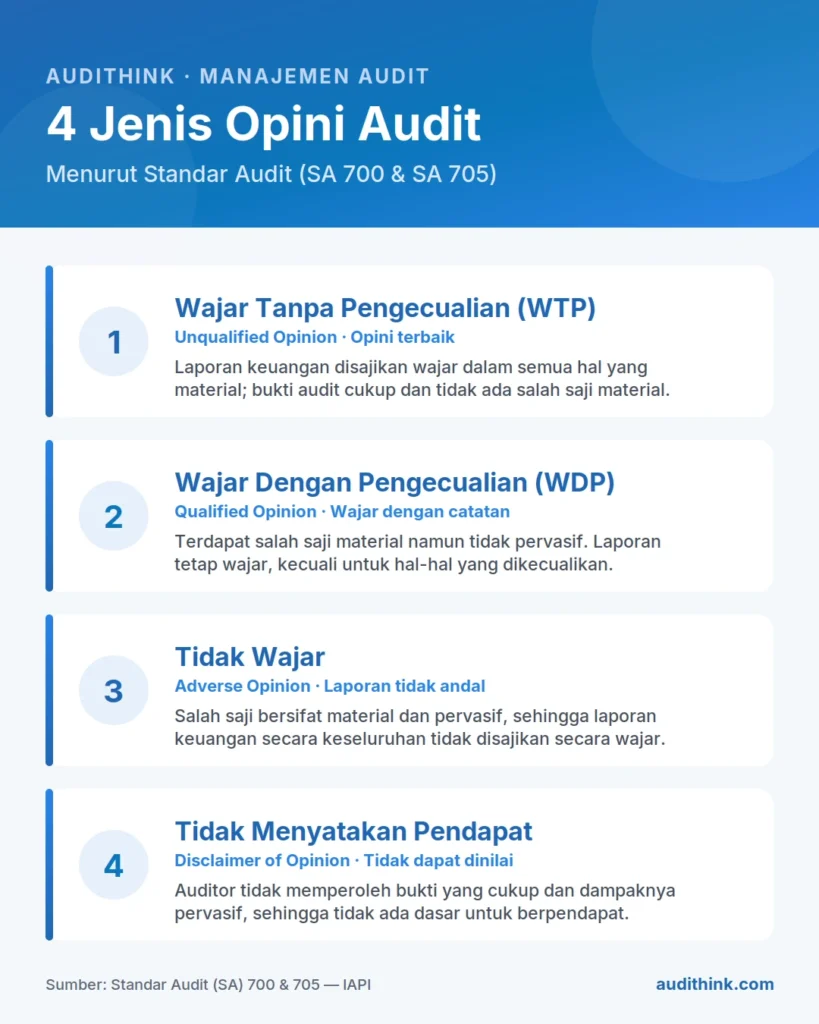
Auditing Standards (SA 700 and SA 705) recognize four types of audit opinions. The following explains each.
1. Unqualified Opinion (WTP)
The best opinion an auditor can provide. An unqualified opinion states that the financial statements are presented fairly, in all material respects, in accordance with the applicable reporting framework. The auditor obtained sufficient evidence and found no material misstatements.
Under certain conditions, the auditor may add paragraph emphasizing a matter (emphasis of matter) without changing the WTP opinion—for example to reveal the issue of business continuity (going concern) which have been adequately disclosed in the report.
See also: What is an unqualified opinion? - Definition, examples and how to get
2. Qualified Opinion (WDP)
The auditor provides a WDP opinion when he finds a material misstatement. non-pervasive (not comprehensive), or when sufficient audit evidence cannot be obtained on a particular matter, but the impact is limited. This means that the financial statements as a whole are still fair, except for the excluded matters.
See also: Qualified Opinion: Definition, Basis for Issuance, & Implications
3. Adverse Opinion
An adverse opinion is issued when the auditor concludes that misstatements—either individually or in the aggregate—are material and pervasive, so that the financial statements as a whole do not fairly present the entity's condition. This is a serious signal that the financial statements are unreliable.
See also: Unreasonable opinions on Auditing: definition, implications, and how to avoid
4. Disclaimer of Opinion
The auditor does not express an opinion when unable to obtain sufficient and appropriate audit evidence, and the potential impact of the unavailability of such evidence is material and pervasive. In this situation, the auditor declines to provide an opinion because there is no sufficient basis to conclude that the report is fair.
Important notes: “Disapproval opinion” or disclaimer often mistaken for a separate type. By default, a refusal to give an opinion same as disclaimer of opinion—both refer to the same condition, namely that the auditor does not have a sufficient basis for an opinion.
See also: What is opinion not expressing an opinion? - Definition and basis of awarding
How Auditors Determine the Type of Opinion
Choosing an opinion follows a standard logic, not free judgment. The auditor answers two questions: what is the nature of the issue, and how widespread is its impact.
| Nature of the issue | Material, not pervasive | Material and pervasive |
|---|---|---|
| The financial statements contain a misstatement | Qualified opinion | Adverse opinion |
| The auditor is unable to obtain sufficient evidence | Qualified opinion | Disclaimer of opinion |
What Does Pervasive Mean in Audit?
Pervasive is a characteristic of an effect that is not confined to a particular item, but spreads to affect the financial statements as a whole. An effect is generally considered pervasive if it is not confined to a specific element or account, if it represents a substantial proportion of the financial statements, or if it concerns disclosures fundamental to the reader's understanding.
This is the concept that separates a qualified opinion from an adverse opinion. If the issue can still be “contained” to a specific item, the opinion is a qualification; if it has spread, the opinion becomes adverse or a disclaimer of opinion.
Comparison Table of 4 Types of Audit Opinions
| Types of Opinions | English terms | Conditions of Grant | Report Reliability Level |
|---|---|---|---|
| Fair without exception (WTP) | Unqualified Opinion | There is no material misstatement; sufficient evidence | High |
| Fair with exceptions (WDP) | Qualified Opinion | Material but not pervasive misstatement | Enough, with a note |
| Unreasonable | Adverse Opinion | Material and pervasive misstatements | Low / unreliable |
| Not Expressing an Opinion | Disclaimer of Opinion | Insufficient evidence, pervasive impact | Cannot be assessed |

Audit Opinion in the Context of the Public Sector (BPK)
For government financial reports—both the Central Government Financial Report (LKPP), Regional Government Financial Report (LKPD), and BUMN/BUMD—opinions are provided by the Audit Board of Indonesia (BPK) with four types of opinions that are equivalent to audit standards:
- WTP (Unqualified Opinion) — highest opinion, often becomes the performance target of government agencies and state-owned enterprises.
- WDP (Fair With Exceptions)
- TMP (Disclaimer)
- TW (Unnatural)
For public sector entities and state-owned enterprises, obtaining an unqualified opinion from the BPK is not just a formality, but an indicator of accountability and good financial governance (good governanceThis opinion is often part of the key performance indicators (KPI) and is of concern to the Inspectorate and the Internal Audit Unit (SPI).
Factors Affecting Audit Opinion
Several factors determine the type of opinion the auditor gives:
- Sufficiency and accuracy of audit evidence. The more complete and reliable the evidence, the stronger the auditor's basis for issuing an unqualified opinion. Limited evidence can lead to an unqualified opinion or a disclaimer.
- The level of materiality and pervasiveness of misstatements. Minor misstatements may be ignored; material misstatements determine whether the opinion is WDP, adverse, or other.
- Effectiveness of internal control. Weak internal controls increase the risk of misstatement and affect the extent of testing and the auditor's conclusions.
- Compliance with accounting standards. Material deviations from SAK/SAP can reduce the quality of the opinion.
- Going concern issues. Significant doubt about an entity's ability to continue as a going concern may trigger an emphasis of the opinion paragraph or influence the opinion.
Examples of Audit Opinion Application
The following illustrates how audit opinions arise in practice:
- Public companies obtain WTP after the auditor ensures that the financial statements are presented fairly in accordance with SAK, with adequate internal controls and complete audit evidence.
- The issuer received an unqualified opinion with a paragraph emphasizing going concern. due to a working capital deficit, even though the disclosure has been adequate—the opinion remains fair, but readers are reminded of the sustainability risks.
- BUMD receives WDP from auditors due to the recording of fixed assets that cannot be fully verified, but does not affect the report as a whole.
- Government agencies obtain TMP from the BPK Due to limited evidence on a number of material transactions, the BPK was unable to conclude the fairness of the report.
Audit Opinion FAQs
How many audit opinions are there?
According to the applicable Auditing Standards (SA 700–705), there are 4 types of audit opinions: unqualified opinion, qualified opinion, adverse opinion, and disclaimer of opinion.
Why do some references mention 5 audit opinions?
The classic framework treats “unqualified opinion with explanatory language” as a separate opinion type, bringing the total to five. The current standard no longer treats it as a separate opinion type — it is now an emphasis-of-matter paragraph that does not change the unqualified opinion.
What is an audit opinion in brief?
The audit opinion is the auditor's official statement regarding whether the financial statements are fairly presented in accordance with applicable accounting standards. This opinion is the final conclusion of the audit process.
What does pervasive mean in audit?
Pervasive is a characteristic of an effect that is not confined to a particular item, but spreads to affect the financial statements as a whole. This is the concept that separates a qualified opinion from an adverse opinion and a disclaimer of opinion.
What does WTP (Unqualified Opinion) mean?
Unqualified Opinion (WTP) means the financial statements are presented fairly in all material respects in accordance with the applicable reporting framework. This is the best opinion an auditor can provide.
What is the difference between an unfair opinion and not stating an opinion?
An adverse opinion is issued when there is a material and pervasive misstatement (the auditor has evidence that the report is incorrect). A disclaimer of opinion is issued when the auditor does not have sufficient evidence to conclude at all.
Who provides the audit opinion for government financial statements?
For government financial reports and some BUMN/BUMD, opinions are given by the Audit Board of Indonesia (BPK) in four categories: WTP, WDP, TMP, and TW.
Does a WTP opinion guarantee that the company is free from fraud?
No. An unqualified opinion (WTP) only assesses the fairness of the presentation of financial reports according to standards, not a guarantee of fraud-free or absolute financial health of the company.
Read also — audit engagements, fees, and tenure:
- Role of Audit Services, types, and Tips for choosing a professional provider
- Audit rotation: definition, objectives, types, examples and regulations
- Audit Tenure: Definition, Benefits, formula, and how to calculate
- How to see Audit fees in financial statements
- Audit Report Lag: definition, factors, and cases in Indonesia
Manage Your Internal Audit Process in a More Structured Way
A quality audit opinion begins with a well-documented audit process—from planning and testing to reporting findings. For internal audit teams in state-owned enterprises (BUMN), regional-owned enterprises (BUMD), and government agencies, managing this entire cycle manually often makes it difficult to track evidence and maintain consistent working papers.
Audithink helps internal audit teams manage planning, working papers, findings, and follow-up in one integrated platform that supports SPIP, Risk-Based Internal Audit, and Good Corporate Governance.
Schedule an Audithink demo to see how our platform can strengthen internal audit and governance processes in your organization.