

Have you ever found that inventory records are not in line with the amount of physical goods in the warehouse? This kind of incompatibility can become a serious problem, especially if left without a solution.
Stock opname comes as an important step to overcome the inaccuracy of inventory data.
Non-conformity not only disrupts smooth operations, but also opens up opportunities for fraud or irregularities in goods.
Without waiting any longer, let's take a deeper look at what an overnight stock is and how to do it so that previous risks can be avoided!
What is a Stock Opname?

Stock opname is an activity of identifying the quantity of goods in the warehouse before marketing or sales activities are carried out. In addition, there are several definitions of stock opname according to experts, namely:
- Sunarto: Stock opname is the process of obtaining the validity of bookkeeping records through the calculation of the quantity of warehouse goods.
- Toto Sucipto: An stock opname is the process of periodically calculating the quantity of finished goods by physically counting the items in the warehouse and then reconciling those quantities with the inventory records.
- Carolina: Stock opname is the process of calculating and adjusting the inventory of goods and company assets in warehouses and storefronts against a database of company records.
This activity includes logging the quantity of warehouse inventory to the placement of goods, making it easier for the process of picking up for delivery
Stock opname also involves checking the feasibility of the condition of the goods in the warehouse before the delivery and production process is carried out.
Purpose Of Stock Opname
In general, stock opname aims to minimize the potential for recording errors so that inventory can be managed properly.
This ensures that the amount of stock is not less or more than what is recorded, so that the company's operational activities can run smoothly.
For example, if the stock in the field turns out to be less than recorded, the company may not be able to meet customer demand on time.
In addition, other objectives are:
1. Prevent Companies From Experiencing Losses
Through stock opname, the company can verify the conformity between the amount of goods owned and the bookkeeping records. Errors in calculations can potentially lead to losses.
For example, there are missing items that are not detected due to lack of supervision when the goods are received, resulting in financial losses for the company.
2. Checking the condition of the goods before shipping

Stock opname also aims to check the physical quality of the goods to prevent the delivery of damaged, expired or defective products.
When damaged goods are shipped, customers will lose trust, causing the business to lose its good reputation.
3. Managing the Inbound and Outbound Goods Process
To monitor the flow of goods more efficiently and prevent discrepancies, companies can conduct inventory counts.
Companies can prevent the loss of goods or discrepancies between shipped and received goods in a more systematic manner.
4. Helping The Success Of The Internal Control System
To create a internal control system successful, the stock calculation should not be missed.
When the stock calculation results do not match the listing, the company can identify and resolve them more quickly.
Thus, internal parties do not have a loophole to manipulate stock data that can harm the company.
5. Simplify The Process Of Goods Restock
Inventory levels can be maintained through a routine inventory calculation process.
When stocks begin to run low, companies can improve production processes.
Conversely, companies can also avoid excess inventory by implementing more efficient production planning.
6. Identify popular products in the market
Consumer demand patterns can also be identified through inventory calculations. Products that often run out indicate their popularity in the eyes of the market.
With this information, the company can adjust the production system to meet customer needs more optimally.
Who Is Involved?
Company or product management is the right party to take on this responsibility.
Assigning tasks to the warehouse or inventory recording should be avoided to prevent bias and potential fraud.
If discrepancies are found during the review, management can evaluate corrective actions and determine who is responsible for ensuring that the error does not recur.
Ideal time for Stock calculation execution
The timing of the inventory count is tailored to each company’s specific needs.
The inventory counting period can be selected from several options, including daily, weekly, monthly, quarterly, semiannual, seasonal, and even annual.
Determination of the implementation time of stock opname is based on several factors, including the type and characteristics of the business, the volume and turnover of stock, as well as the availability of resources.
For example, supermarkets or large retailers that have high transaction rates are advised to ensure stock is maintained every day.
Whereas, fashion companies ideally conduct stock overnight before and after a particular season to ensure stock availability and evaluation.
Sample Stock Opname
The result of the stock calculation process is a report showing the physical condition of the goods in the warehouse. Here we present some reports as illustrative examples of stock opname in the company.
1. Examples Of Physical Goods Stock Opname
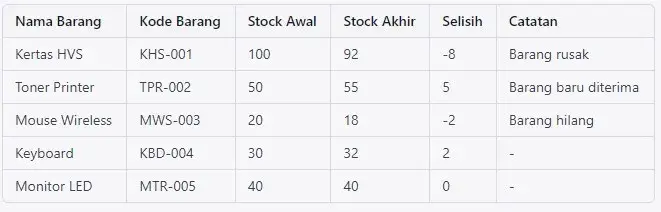
The report comes from the process of capturing physical goods data directly.
Through the example of the report, the company can identify the difference in stock between the initial and final stock, then match it with the record book.
2. Examples Of Stock Opname By Period
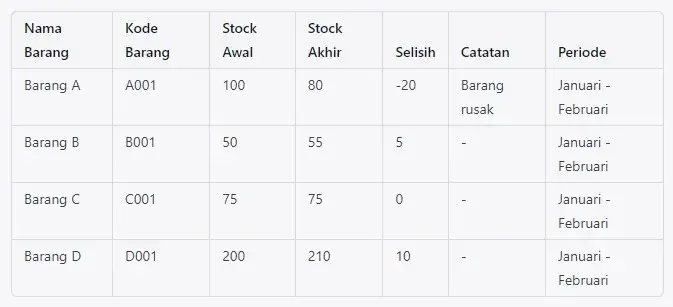
In this example, the calculation is carried out within a certain time range. Businesses can find out if there are errors in bookkeeping in certain periods.
3. An Example Of The Total Stock
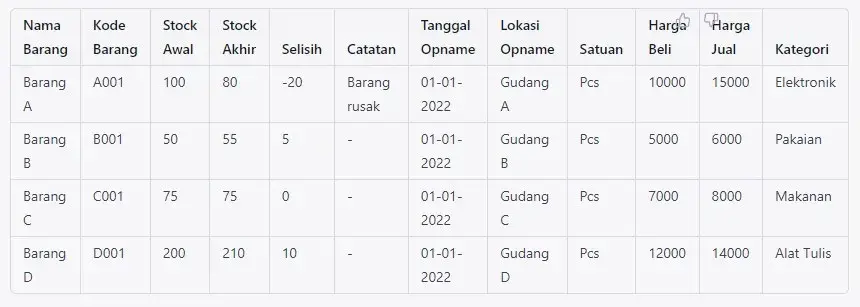
In this stock calculation report, recording covers all aspects, ranging from the location of the opname, selling price and purchase price, to the category of goods, everything will be recorded in detail.
Calculations are also made on all goods produced by the enterprise.
4. Partial Stock Opname Example
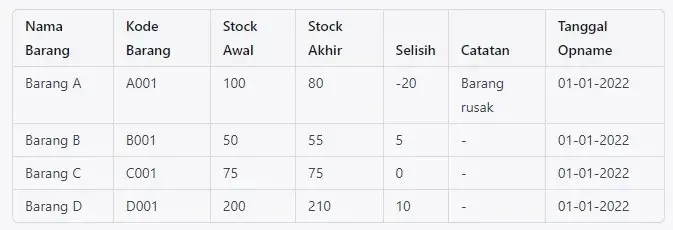
The last example is a partial stock calculation. In this method, not all items are counted, only certain items.
These items are those that have the highest risk of bookkeeping errors or are crucial to business operations.
How to do a good stock Opname
The stock calculation process is not complicated. You can do this through the following steps:
1. Arranging goods as and preliminary preparation
One week before implementation, you can arrange items by category or code to make calculations easier.
Label, tag, or barcode effective to distinguish items that have been calculated with those that have not.
Items that do not need to be counted must also be given a special mark, “not counted” for example.
2. Coordinate the team and close the mutation of goods
The day before the stock opname, a briefing needs to be held to the team involved to provide an understanding of roles and responsibilities.
In addition, make sure all item mutations have been inputted until the closing hours of operations on that day. Finally, additional item mutations should not occur until the stock opname process is complete.
3. Stages of implementation of stock recording and counting
On the day of implementation, there are the following steps that need to be done, namely:
- Ensure all the latest transactions have been recorded in the system then printed and submitted to the accounting team or audit as a reference calculation.
- Perform physical counting of goods according to categories by marking each item that has been counted with labels or tags.
- Record the results of the physical count and compare them with the data in the system.
- If there is a discrepancy, double-check to make sure there are no errors.
4. Make A Report
The report serves as proof that the inventory count has been successfully completed.
Further, the report must be provided to the accounting or audit team to revise the quantity of inventory in the bookkeeping as well as the management to be evaluated.
Audit Software as a stock Opname solution
Did you know, stock opname plays an important role in audits by helping to ensure conformity between physical stock and bookkeeping records.
With the audit software such as Audithink, activities become much easier.
Audit Software will facilitate the recording of stock operated, so that the data is always accurate and up-to-date.
In addition, this software also helps in monitoring stocks at risk of miscalculation, and automatically generates reports that can be directly used for audits.
Contact we are now!