

Did You Know? There are web server which has an incredible speed, it can even handle up to ten thousand connections simultaneously. The services offered are also widely used by websites that have traffic high.
With the advantages that have been mentioned at a glance earlier, what is the web server? By reading this article, you should already know its name. NGINX is the name of the web server.
No need to go into detail anymore, let's see together a complete explanation of what NGINX is.
What is NGINX?

NGINX is a software that is well known for its ability to function as a high-performance web server. Designed to handle billions of requests efficiently, NGINX is capable of managing high and persistent connection loads.
The main advantage of NGINX lies in its ability as a reliable proxy server. Selain sebagai server proxy, NGINX juga dapat digunakan untuk reverse proxy, load balancing, dan caching.
NGINX is available for free and offers a wide range of features and functionality at no additional cost. Due to its open source nature, NGINX has become the most popular web server and is used by 33.8% of websites worldwide.
What Is the Function of NGINX?
The following are the functions of NGINX are among others:
1. Web Server
The first NGINX function was as a web server with excellent performance. By adopting an asynchronous event-driven architecture, NGINX can improve speed and stability while handling heavy traffic.
Over time, NGINX has developed and managed to surpass Apache and several other web servers in terms of performance.
Initially, NGINX was only capable of managing a simple HTML server, but now it can handle more dynamic and diverse content, as well as support various aspects of the modern web such as HTTP/2, WebSocket, gRPC, and video streaming in various formats.
2. Beyond Web Serving Functionality
The next function of NGINX is that it has a scalable architecture, making it ideal for tasks other than presenting content to users.
NGINX can handle multiple connections simultaneously, allowing use as a reverse proxy and load balancer to distribute incoming traffic to upstream servers evenly, even if those servers are performing slower.
In addition, NGINX can function as an SSL/TLS terminator or web accelerator, as well as compress and cache content to improve performance.
How Does NGINX Work?
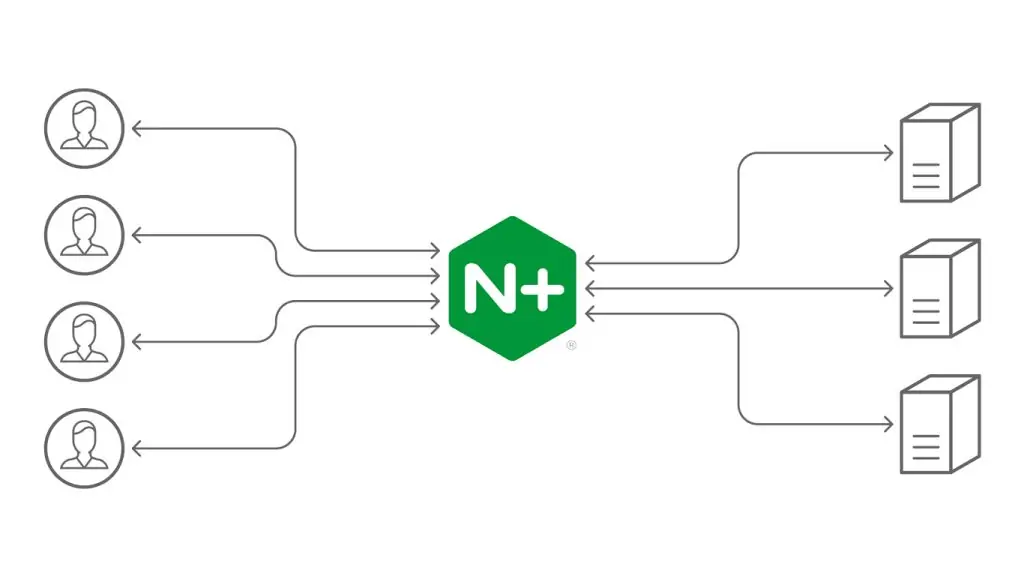
Having previously skimmed over what NGINX is and the functions of NGINX, next we discuss how NGINX works. Here is an explanation of how NGINX works.
When someone sends a request to open a web page, the browser will connect to that web server.
Then, the server will search for the requested page file and send it back to the browser. This process describes how a server operates to fulfill a simple request.
The above example can also be considered as a single thread. In general, other web servers create one thread for each request. However, this does not apply to NGINX. As already outlined, NGINX operates with an event-driven and asynchronous architecture.
This means the same or similar threads are managed under one worker process (worker process), which consists of small units called worker connections (worker connection). This entire unit is in charge of handling thread requests.
The worker connection sends a request to the worker process, which also forwards it to the master process. The master process then displays the result of the request.
Although the way it works looks simple, it is worth noting that one worker connection can handle up to 1024 similar requests. This is what allows NGINX to process thousands of requests without experiencing any difficulties.
This ability makes it a top choice for websites with high traffic, such as ecommerce, search engines, and cloud storage.
What Are the Advantages of NGINX?
Software this web server is the main choice for large companies in the world thanks to its various advantages. Therefore, some of the advantages of NGINX are as follows.
1. Efficient Use Of Resources
The advantage of NGINX is that it can work with less memory compared to others. Software it is lighter and does not require as much capacity Random Access Memory (RAM), so that your computer can work more efficiently when running this web server.
2. Alternatif Load Balancer Hardware
The second advantage of NGINX is as software load balancer open-sourceAddition, NGINX offers a more economical solution and a simpler configuration than the device load balancer hardware. NGINX is also suitable for modern cloud environments, supports live configuration, and integrates with DevOps for seamless monitoring.
3. Multifunction
Igor has developed NGINX into a multifunctional application, not just as a web server. You can utilize this application to manage various tools used in website development.
4. Protection Against DDoS Attacks
Websites are vulnerable to DDoS attacks that can disrupt operations. NGINX ensures the security of website servers against these attacks with its security features.
5. Periodic Updates
The last advantage of NGINX is that even though it is widely used, NGINX continues to get updates from its developers. Today, NGINX drives the development of HTTP technology and supports all forms of microservices.

What Are the Disadvantages of NGINX?
With the advantages mentioned earlier, of course this web server also has some disadvantages. Here are some disadvantages of NGINX, among others:
1. Limited Compatible
The first drawback of NGINX is that NGINX performance is not always optimal on some operating systems other than Linux, MacOS X, and Solaris. This means Windows users may not be able to experience the full benefits of NGINX even though the software can be easily installed on their devices.
2. Limited community support
The second drawback of NGINX is that although it has many advantages, NGINX is still poorly supported by the community. As a result, there are some problems that do not have adequate reference support and documentation.
3. Minimal flexibility
The third drawback of NGINX is that this web server is still considered less flexible to meet various needs. The problem is, NGINX does not yet have complete modules and add-ons, one of the features that does not yet exist is Tools .htaccess.
What Is the Difference Between NGINX and Apache?
Apache and NGINX are two very popular web servers around the world. Based on statistical data, NGINX is used by 34% of websites on the internet, while Apache is used by 33.5%.
Although both have powerful features, NGINX is faster and more efficient in handling multiple connections simultaneously, while Apache is easier to configure and more flexible in handling various types of web tasks. Therefore, the choice between the two depends on the needs and preferences of the user.
To get more complete information, here are some points of difference between Apache and NGINX, among others:
1. Operating System Support
The striking difference between NGINX and Apache can be seen from the operating system support available for each web server. Both web servers are popular, but the operating system support is different. NGINX and Apache work well on Unix operating systems, but NGINX suffers performance degradation when run on Windows operating systems.
2. User Support
Both NGINX and Apache have differences in terms of user support or user support. Given the large number of users, each web server has an active user forum.
This allows interaction between users and developers to provide input in the development of both web servers. With the support of a wide community, NGINX and Apache can continue to grow and improve its quality.
3. Performance
In terms of performance, NGINX and Apache show clear differences. Both of these web servers have good speed in responding to requests. However, NGINX excels at handling larger loads than Apache, making it more ideal for websites that have static content.
FAQ About NGINX
What is NGINX?
NGINX is open source software known as a high-performance web server , designed to handle billions of requests efficiently. Besides being a web server, NGINX is also used for reverse proxy, load balancing, and caching.
How does NGINX work?
NGINX uses an event-driven , asynchronous architecture. Instead of creating one thread per request, similar requests are managed in one worker process consisting of worker connection — and one worker connection can handle up to 1024 similar requests.
What are the functions of NGINX?
As a high-performance web server supporting HTTP/2, WebSocket, gRPC, and video streaming ; and going beyond web serving — working as a reverse proxy and load balancer, SSL/TLS terminator, web accelerator, and content compressor and cache store.
What are the advantages of NGINX?
Efficient in resource use because it needs less memory, an economical alternative to load balancer hardware, multifunctional for various web development needs, providing protection against DDoS attacks, and continuously receiving regular updates from its developers.
What are the drawbacks of NGINX?
Limited compatibility because its performance is not optimal outside Linux, macOS X, and Solaris; community support not yet as broad as other web servers so some problems have little documentation; and module flexibility that is still limited — for example, no .htaccess.
What is the difference between NGINX and Apache?
Both run well on Unix, but NGINX's performance drops on Windows. In performance terms, NGINX is superior at handling heavy loads and suits static content, while Apache is easier to configure and more flexible for various web tasks.
Conclusion
In conclusion, NGINX is an open-source web server software that is renowned for its ability to handle high connection traffic with efficient performance.
In addition to serving as a web server, NGINX can also be used for reverse proxying, load balancing, and caching, making it a popular choice for high-traffic websites.
The advantages of NGINX lie in the efficient use of resources, multifunctionality and protection against DDoS attacks. However, NGINX also has disadvantages such as limited compatibility on some operating systems and lack of module flexibility.
Lastly, if you are looking for the best audit app, trust Audithink. The features of the application that we offer are in the form of planning, supervision, and much more. Contact Contact Us to consult on the needs of your audit team.