

Audit assertions are statements by management, either express or implied, regarding the accuracy of each component in the financial statements, which form the basis for auditor to design test procedures. Every figure presented by management contains a claim: that transactions occurred, balances exist, amounts are correct, and disclosures are complete. The auditor's job is to test whether these claims are substantiated.
Based on Auditing Standard (SA) 315 Published by the Indonesian Institute of Certified Public Accountants (IAPI), in line with ISA 315 (Revised), audit assertions are grouped into three main categories, encompassing a total of 13 assertions. This article discusses their definition, latest classification, function, examples, and application in the modern audit process.
Important notes: Many older references still refer to the "five types of assertions" (existence, completeness, rights and obligations, valuation, and presentation). This framework stems from previous standards. Current auditing standards group them into three categories based on the object being audited. This article uses the current classification.
What is an Audit Assertion?
Literally, assertion means a statement or affirmation of something believed to be true. The Indonesian word for this is derived from the English assertion. In the context of accounting and audit, an assertion is management's claim regarding the truthfulness of every figure and disclosure presented in the financial statements. So when someone mentions “assertion” in an audit discussion, what is meant is that claim, not just an ordinary statement.
Audit assertions (audit assertions or management assertions) is management's representation of transactions, account balances, and disclosures in the financial statements. When management presents financial report, they implicitly state that each element meets certain criteria, for example that the recorded inventory actually exists and is owned by the entity.
Assertions serve as the reference point for testing. Auditors do not randomly test financial statements, but rather map each account to the relevant assertion and then design audit procedures to obtain evidence for each assertion. This is why assertions are the foundation for risk assessment and audit program development.
Assertions can be explicit (stated in writing in the management representation letter) or implicit (attached to the presentation of the numbers themselves).
See also: Guide to Implementing Audit Assertions in Internal Audits
Management Assertions and Audit Assertions: The Same Term?
In practice, management assertions and audit assertions refer to the same object, only viewed from a different angle. It is called a management assertion because management is the party making the claim. It is called an audit assertion because that claim becomes the target of the auditor's testing. The auditing standard itself uses the term assertions without a prefix, and SA 315 defines it as a representation by management.
The difference only becomes clear when discussing responsibility. Management is responsible for preparing the financial statements along with every claim embedded in them. The auditor does not make any assertions; the auditor gathers evidence to assess whether management's assertions can be sustained. That is why the phrase “the auditor makes an assertion” is conceptually incorrect.
Another term that often comes up is financial statement assertions. The meaning stays the same; the emphasis is simply on the document to which the assertion is attached.
What Are the Categories and Types of Audit Assertions?
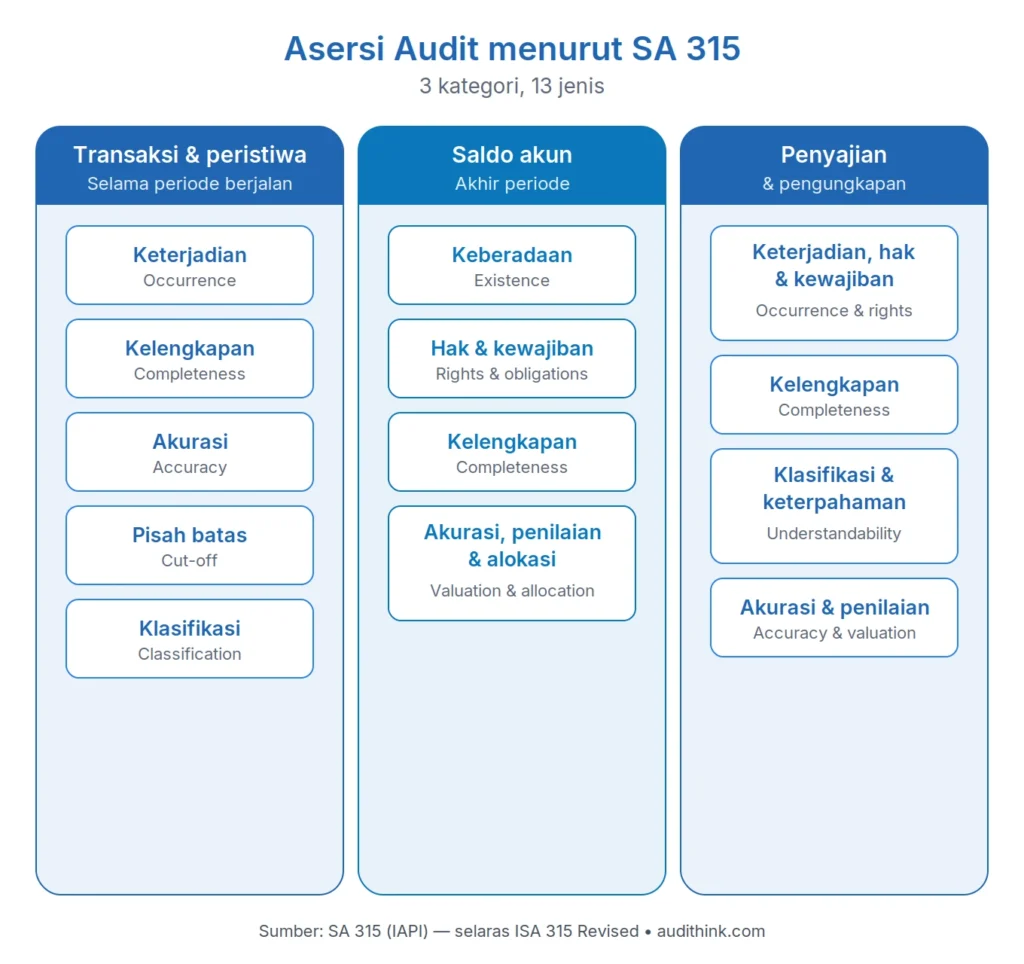
According to SA 315, assertions are classified based on the objects being audited: transactions during the current period, account balances at the end of the period, and presentation and disclosure.
| Category | Assertion | Key Questions Tested |
|---|---|---|
| Transaction & event categories | Occurrence | Did the transaction actually happen? |
| Completeness | Have all transactions been recorded? | |
| Accuracy | Are the numbers and data recorded correctly? | |
| Cut-off (Boundary Separator) | Are transactions recorded in the correct period? | |
| Classification | Are transactions recorded in the correct accounts? | |
| End of period account balance | Existence | Do assets, liabilities, and equity really exist? |
| Rights & Obligations | Does the entity have rights to assets and obligations to liabilities? | |
| Completeness | Have all balances been recorded? | |
| Accuracy, Valuation & Allocation | Is the balance valued at the correct amount? | |
| Presentation & disclosure | Occurrence, Rights & Obligations | Did the events disclosed actually occur and involve the entity? |
| Completeness) | Have all the disclosures that should have been made been presented? | |
| Classification & Understandability | Is the information presented clearly and easily understood? | |
| Accuracy & Valuation | Is financial information disclosed in appropriate amounts? |
1. Assertions on Classes of Transactions and Events
This category examines transactions that occurred during the current period, such as sales, purchases, and payroll.
- Occurrence: The recorded transactions actually occurred and relate to the entity. Examples: The recorded sales of Rp5 billion are supported by valid invoices and proof of delivery — not fictitious sales.
- Completeness: All transactions that should have been recorded have been recorded. Examples: There are no purchases that are intentionally not recorded to reduce the burden.
- Accuracy: Amounts and other data are recorded correctly. Examples: invoice value, quantity and tax calculation are correct.
- Cut-off: Transactions are recorded in the correct accounting period. Examples: December 30 sales are not shifted to January to increase profits for the following year.
- Classification: Transactions are posted to the proper accounts. Examples: repair costs were not incorrectly recorded as additions to fixed assets.
2. Assertions on Account Balances at the End of the Period
This category examines the balances that appear on the balance sheet (statement of financial position), such as cash, inventory, accounts receivable, and accounts payable.
- Existence: The assets, liabilities, and equity recorded actually exist at the reporting date. Examples: Inventory worth Rp2 billion on the balance sheet can be verified through physical stocktaking.
- Rights and Obligations: The entity has rights to assets and bears obligations for liabilities. Examples: Capitalized lease assets properly reflect the entity's lease rights and liabilities.
- Completeness: All assets, liabilities, and equity that should have been recorded have been recorded. Examples: there are no outstanding debts.
- Accuracy, Valuation & Allocation: Balances are presented at the correct amounts, including valuation adjustments. Examples: Trade receivables are presented at net realizable value after deducting allowance for impairment losses.
3. Assertions on Presentation and Disclosure
This category examines how information presented and expressed in the financial statements and notes to the financial statements (CALK).
- Occurrence, Rights, and Obligations: The events and transactions disclosed actually occurred and relate to the entity.
- Equipment: All disclosures required by accounting standards have been presented.
- Classification and Understandability: Information is presented and explained clearly. Examples: Long-term and short-term liabilities are classified appropriately according to their maturity.
- Accuracy and Assessment: Financial and other information is disclosed fairly and in appropriate amounts.
What Is the Function of an Audit Assertion in the Audit Process?
Assertions are not merely theoretical concepts; they determine how audits are conducted. Here are their primary functions.
- Basis of risk assessment. The auditor identifies which assertions are at greatest risk of material misstatement and then focuses audit resources there.
- Planning framework audit procedure. Each procedure (confirmation, observation, inspection, recalculation) is designed to test a specific assertion. For example, a confirmation to the bank tests the assertion existence sweet thing.
- Communication bridge between auditors and management. When an assertion is in doubt, the auditor may request clarification and evidence directly from management.
- Improved test accuracy and coverage. By mapping accounts to assertions, no material aspects are missed from testing.

What Are the Benefits of Audit Assertions for Companies?
- Improve the validity of financial reports. Reports that pass the test of all assertions have higher reliability in the eyes of stakeholders.
- Strengthening compliance and risk management. The assertion framework helps management identify internal control weaknesses before they become findings.
- Increase trust and reputation. Thoroughly tested financial reports strengthen the confidence of investors, creditors, regulators, and business partners.
- Supports more efficient audits. Focusing on high-risk assertions makes for more optimal allocation of audit time and resources.
See also: Audit Assertions in the GRC Framework for Risk Control
What Are Examples of Audit Assertion Application?

Suppose an auditor is auditing accounts receivable worth Rp3 billion. The auditor will test several assertions simultaneously:
- Existence — send a confirmation letter to the customer to ensure that the receivable actually exists.
- Equipment — review shipping documents to ensure there are no unrecorded credit sales.
- Rights and obligations — ensure that the receivables have not been secured or shifted (factoring) to the other party.
- Accuracy & assessment — evaluate the adequacy of the allowance for doubtful accounts so that the balance reflects the net realizable value.
- Boundary divider — check transactions near the end of the period to ensure they are recorded in the correct period.
From a single account, auditors test five different assertions. This is why understanding assertions is a fundamental competency for every internal and external auditor.
See also: Common Mistakes in Using Audit Assertions
In practice, assertion testing across many accounts and branches is often scattered across separate spreadsheets, making it hard to monitor. If your team is starting to consider software to organize it, we have summarized a comparison of several options in 7 Best Internal Audit Management Software for Business in 2026.
FAQ About Audit Assertions
Asersi artinya apa?
Assertion means a statement or affirmation of something believed to be true, derived from the English word assertion. In accounting and audit, an assertion is management's claim that every figure and disclosure in the financial statements is presented accurately, completely, and in accordance with standards.
Apa bedanya asersi manajemen dan asersi audit?
Keduanya merujuk pada hal yang sama, hanya berbeda sudut pandang. Disebut asersi manajemen karena manajemen yang membuat klaim, dan disebut asersi audit karena klaim itu menjadi sasaran pengujian auditor. Auditor sendiri tidak membuat asersi, ia hanya menguji asersi manajemen.
Apa saja 5 asersi audit yang sering disebut?
The old framework named five assertions: existence, completeness, rights & obligations, valuation, and presentation and disclosure. This framework is still often used in course materials, but the current standard (SA 315) has replaced it with 3 categories covering 13 assertions.
What is an audit assertion in brief?
Audit assertions are management's statements—expressed or implied—that each component of the financial statements is presented accurately, completely, and in accordance with standards. Assertions form the basis for the auditor's design of testing procedures.
How many types of audit assertions are there?
According to ISA 315 (aligned with ISA 315 Revised), assertions are grouped into three categories: transactions and events, account balances, and presentation and disclosure—containing 13 assertions. The old “5 types” framework originated from the previous standard and has now been updated.
What is the difference between existence and completeness assertions?
Existence tests whether what is recorded actually exists (risk) more servings/overstatement). Completeness tests whether what should have been recorded (risk) underserved/understatement). Both move in opposite directions.
Who makes audit assertions — the auditor or management?
Assertions made by management, not the auditor. Management is responsible for the financial statements, while the auditor is responsible for testing whether the assertions are proven.
How are assertions used in internal audits?
Internal auditors use assertions to evaluate the reliability of reporting, test the effectiveness of internal controls over each assertion, and focus audits on high-risk areas. Audit management software helps structure the mapping of testing procedures to each assertion.
Manage More Structured Audit Assertion Testing with Audithink
Manually testing dozens of assertions across multiple accounts and branches is prone to misses and time-consuming. Audithink, internal audit management software for companies and state-owned enterprises in Indonesia, helping internal audit teams map testing procedures to each assertion, document evidence, and monitor follow-up on findings in one integrated platform — from planning to reporting.
Schedule an Audithink Demo to see how our platform supports risk-based and assertion-based auditing.
Consultation with the Audithink Team to discuss your company's internal audit needs.