

The accuracy of financial statements is an important foundation for a business in making the right decisions.
To ensure this, an unqualified opinion is the expected outcome of the audit process.
In this article, we will discuss what an unqualified opinion is and the steps to achieve it!
What Is the Meaning of an Unqualified Opinion?

An unqualified opinion (WTP) is an independent auditor's statement that a business's financial statements have been fairly presented in all material respects.
This means that important elements such as the company's financial condition, cash flow, and results of operations are in accordance with applicable accounting principles.
The compliance standards referred to in this opinion may be Financial Accounting Standards (SAK) in Indonesia or Generally Accepted Accounting Principles (GAAP) in other countries.
This opinion is the highest level in audit opinion because it confirms the absence of material errors or discrepancies in the company's financial statements.
Unqualified Opinion Is the English Term for WTP
Unqualified opinion is the English term for opini wajar tanpa pengecualian. This term is more often used in international auditing standards (ISA) and English-language audit literature, while “wajar tanpa pengecualian” or abbreviated WTP is its equivalent in the Auditing Standards (SA) in Indonesia. Both refer to the same thing: the highest audit opinion, stating the financial statements are free of material misstatement.
What Are the Requirements for Obtaining an Unqualified Opinion?
This opinion can be given by the auditor if the following three conditions are met
- There are no restrictions on the scope of the examination. If there are restrictions, they are not material and can be overcome by alternative procedures.
- Auditors not subjected to pressure from the other party during the inspection process.
- No offense against accounting standards. If there is a violation, then the violation is not of a material nature.
What Are the Benefits of Obtaining an Unqualified Opinion?
A WTP opinion gives users of financial statements a stronger basis to trust the figures presented. Benefits commonly experienced by entities include:
- Stakeholder trust: owners, investors, and creditors receive an independent statement that the financial statements are fairly presented in all material respects.
- Smoother financing process: banks and funders generally ask for audited financial statements, and a clean opinion reduces follow-up questions about the reliability of the figures.
- Support for reporting compliance: audited financial statements help entities meet reporting obligations to regulators or funders, in accordance with the rules that apply to that entity.
These benefits have limits: a WTP opinion is not a guarantee of good performance or freedom from fraud, as discussed in the next section.
What Are the Strategies for Obtaining an Unqualified Opinion?
To get the success of the audit results, here is a strategy that you can apply.
- Transparent and accurate financial system management: Management includes recording every transaction in a timely and transparent manner will increase auditor confidence in the data provided.
- Compliance with applicable accounting standards: Following the latest accounting standards, will reduce the risk of non-conformity of financial statements.
- Improvement Of Internal Audit Procedures: Internal audit plays an important role in identifying and correcting errors before external audits are conducted.
- Consistent and error-free reporting of Material: To obtain a WTP opinion, financial statements must be consistent and free from material errors.
- Compliance with tax regulations: Errors in tax reporting or tax arrears can lead to an unreasonable opinion of the auditor. Therefore, the company must comply with all applicable tax provisions.
- Support external auditors with information needed: By providing complete and open data and facilitating the audit process, the company will make it easier for auditors to make their assessments.
- Effective risk management: Risk identification and proper management will minimize the potential for violations in the financial statements so that all transactions are in accordance with applicable regulations.
- Accounting Education and training for Finance staff: Equipping financial staff with the latest accounting training really helps maintain the quality of financial statements.
What Are Examples of Unqualified Audit Opinion Reports?
Here are some references to the auditor's opinion with unqualified type.
Example 1
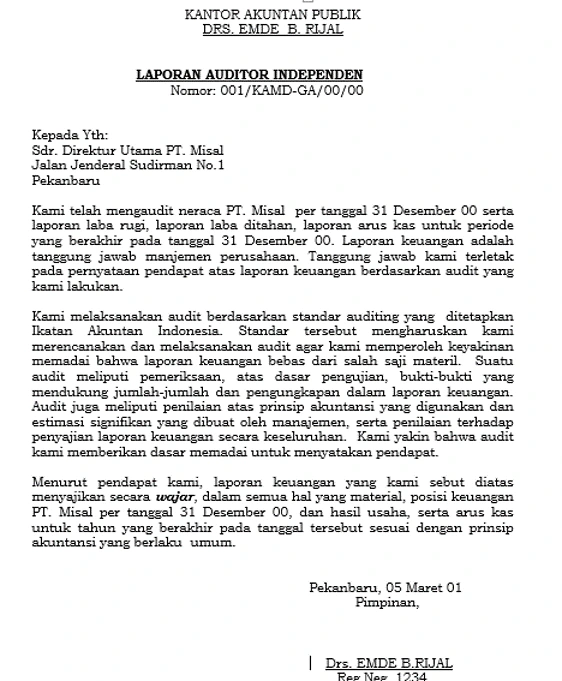
The independent auditor's report is published by a public accounting firm.
Auditors certify that they have audited the company's financial statements, which consist of the balance sheet, income statement, retained earnings, and cash flows.
Based on audit results, auditor provide unqualified opinion, which means that the financial statements are stated to be reasonable in all material respects.
Example 2
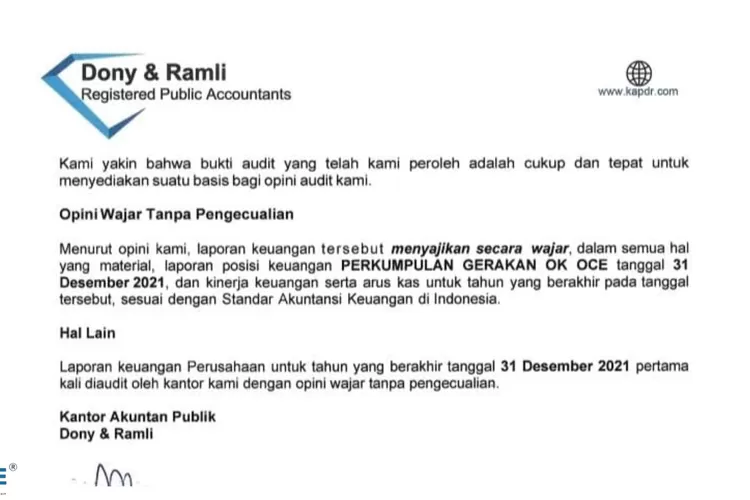
This report is made by a public accounting firm.
The Auditor certifies that the financial statements reasonably present the financial position and financial performance for the period.
The audit results stated that the financial statements in accordance with Financial Accounting Standards in Indonesia.
Example 3
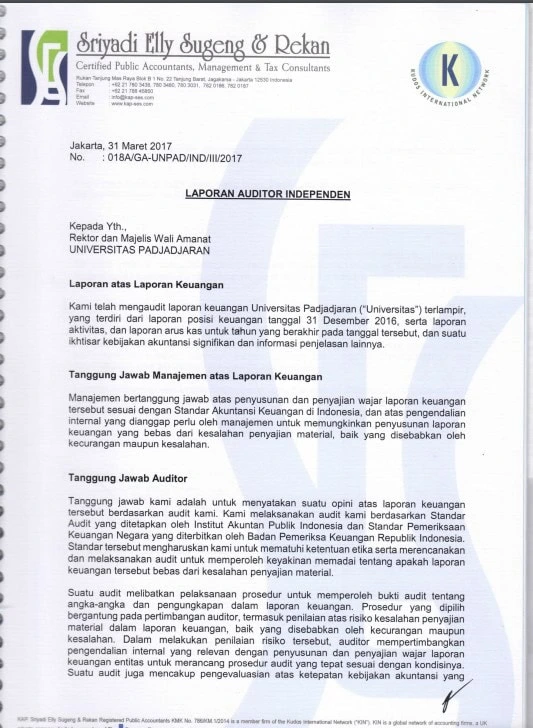
This independent auditor's report comes from a public accounting firm for a university.
The financial statements of the University are asked by the auditor that they have been prepared in accordance with Financial Accounting Standards.
This report also includes the responsibilities of management and auditors in the process of preparing and auditing financial statements.
These three reports provide unqualified opinions that indicate that the financial statements of each company or agency are in accordance with applicable accounting standards and are free from material misstatements.
What Is an Illustrative Example of Misstatements Below Materiality?
The following example is fictional and for illustration only. There is no fixed threshold for all entities: materiality materiality is set by the auditor based on professional judgment about the size and nature of the entity. Assume the auditor of PT Contoh Maju sets materiality at Rp500 million for the financial statements as a whole.
| Condition found | Auditor's assessment | Impact on the opinion |
|---|---|---|
| Two uncorrected misstatements: cost misclassification of Rp40 million and a sales cut-off error of Rp60 million (total Rp100 million) | Below materiality, both individually and combined | A WTP opinion can still be issued |
| Uncorrected receivables misstatement of Rp800 million, in one account only | Exceeds materiality, but not pervasive | Qualified opinion |
This example simplifies practice. Auditors also assess the nature of a misstatement, not just its amount: a small misstatement that conceals a violation of regulations or turns a loss into a profit may be judged material. The condition in the second row is discussed in more detail in the article qualified opinion.
Does this opinion reflect the company's Financial Performance?
Unqualified opinion (WTP) does not directly describe the company's financial performance.
When the auditor gives this opinion, it is not a reflection of whether the client's financial condition but only an affirmation that the financial statements have been prepared in accordance with applicable accounting principles.
The Auditor may also give an opinion going concern although accompanied by reasonable opinion without exception if there are indications.
Opinion going concern inform of the potential inability of the business to continue to operate properly.
Factors that trigger opinions going concern various, For example, due to a significant decline in financial performance or failure of the company to meet its credit obligations.
Does a WTP Opinion Guarantee Financial Statements Free of Fraud?
No. A WTP opinion states that the financial statements are fairly presented in all material respects, not that there is no fraud at all. Auditing standards (SA 200 and SA 240) place the audit objective on reasonable assurance, not absolute assurance, so there is always a risk that a material misstatement due to undetected fraud remains, especially when it involves collusion or forged documents.
Fraud that is below materiality, or that does not affect the presentation of the financial statements, can also slip through without changing the opinion. Therefore, WTP is better read as an affirmation of fair presentation, not a certificate of integrity. Prevention and detection of fraud remain primarily the responsibility of management and those charged with governance through internal control.
What Is an Unqualified Opinion With an Emphasis of Matter Paragraph?
An unqualified opinion with an additional paragraph is given when the financial statements are free from material misstatements but there is important information that needs to be explained further.
The explanation serves to provide a better understanding of the client.
In this situation, the auditor adds an explanatory paragraph after the main opinion to draw the user's attention to certain significant points.
For example, an explanation of financial material uncertainties related to certain conditions, the impact of major disasters experienced by the company, transactions with related parties, or issues going concern.
What Does WTP Mean in Government Financial Statements (BPK Opinion)?
For the financial statements of ministries/agencies and local governments, the opinion is given by the Audit Board of the Republic of Indonesia (BPK), not by a public accounting firm. Its basis is Law Number 15 of 2004: Article 16 paragraph (1) states that audit reports on government financial statements contain an opinion, and its elucidation lists four criteria for forming the opinion:
- conformity with Government Accounting Standards (SAP);
- adequacy of disclosure;
- compliance with laws and regulations;
- effectiveness of the internal control system (SPI).
The WTP term is the same, but the reference is different. BPK uses the State Financial Audit Standards (SPKN) and SAP, while auditors at public accounting firms use the Auditing Standards (SA) from IAPI, for example SA 700 for unmodified opinions, SA 705 for modified opinions, and SA 706 for emphasis-of-matter paragraphs.
SPKN is currently regulated in BPK Regulation Number 1 of 2017. BPK Regulation Number 1 of 2026 on SPKN was issued on 10 April 2026 and will revoke the 2017 regulation, but it only comes into force two years after promulgation, that is, after 10 April 2028.
Where Does an Unqualified Opinion Stand Among the 4 Types of Audit Opinions?
WTP is the baseline opinion: the auditor gives it precisely because they did does not not find any material issue. Once there is an issue, the auditor moves to one of three other opinions based on two questions — is the issue material, and is it pervasive (spreading to many parts of the statements) or not:
| Nature of the issue | Material, not pervasive | Material and pervasive |
|---|---|---|
| The financial statements contain a misstatement | Qualified opinion | Adverse opinion |
| The auditor is unable to obtain sufficient evidence | Qualified opinion | Disclaimer of opinion |
Read the complete comparison of the four opinion types in the pillar article on audit opinion, or learn each one individually: qualified opinion, adverse opinion, and disclaimer of opinion.
See also:
- Audit Report: Definition, Functions, Types, & Examples
- Complete Guide to the external Auditor profession: duties, roles and salary
FAQ About Unqualified Opinions
What is an unqualified opinion?
An unqualified opinion (WTP) or unqualified opinion is an independent auditor's statement that a business's financial statements have been presented fairly in all material respects, in accordance with applicable accounting principles such as SAK in Indonesia or GAAP in other countries. It is the highest level of audit opinion.
What are the requirements for obtaining an unqualified opinion?
There are three requirements: no limitation on the scope of the examination (or the limitation is immaterial and can be overcome with alternative procedures), the auditor faces no pressure from other parties during the examination, and there are no material violations of accounting standards.
Does an unqualified (WTP) opinion mean the company's financial performance is good?
No. A WTP opinion is not a reflection of the company's financial condition, but an affirmation that the financial statements were prepared according to applicable accounting principles. The auditor can even issue a going concern opinion even alongside an unqualified opinion if there are indications of it.
What is an opinion on going concern?
Opinion going concern informs of the potential inability of the business to continue operating properly. The triggers vary — for example, a significant decline in financial performance or the company's failure to meet its credit obligations.
What is a WTP opinion with an additional explanatory paragraph?
This opinion is given when the financial statements are free of material misstatement but there is important information that needs further explanation. The auditor adds an explanatory paragraph after the main opinion — for example about uncertainty over a financial matter, the impact of a major disaster, related-party transactions, or an issue of going concern.
What strategies help a company obtain a WTP opinion?
Manage the financial system transparently and accurately, meet the latest accounting standards, improve internal audit procedures before the external audit, keep reporting consistent and free of material errors, comply with tax regulations, support external auditors with complete data, apply effective risk management, and equip finance staff with up-to-date accounting training.
Is a WTP-audited financial report certainly free of fraud?
No. Auditors provide reasonable, not absolute, assurance that the financial statements are free from material misstatement. Fraud that is concealed, involves collusion, or is below materiality may go undetected without changing the WTP opinion.
Who gives the WTP opinion on local government financial statements?
The Audit Board of the Republic of Indonesia (BPK). Its opinion is formed on four criteria: conformity with government accounting standards (SAP), adequacy of disclosure, compliance with laws and regulations, and effectiveness of the internal control system.
Conclusion
Unqualified opinion (WTP) is an auditor's statement stating that the company's financial statements have been prepared reasonably and in accordance with applicable accounting standards.
This opinion is the highest audit opinion is not a direct reflection of the company's financial condition, but rather a guarantee that the report is prepared correctly and accurately.
This opinion may also include additional explanatory paragraphs if the auditor feels that there is important information that must be considered.
This opinion can be achieved thanks to the support of internal audit software such as Audithink which improves the quality and accuracy of the audit process.
With real-time automation and compliance monitoring, an audit software we ensure that any potential deviations or material errors can be detected and corrected.
Contact us now!