

A qualified opinion (qualified opinion) is the auditor's opinion stating that the financial statements are fairly presented, except for the effect of a specific matter that is excluded. Often abbreviated WDP.
The key word is in the phrase “except for”. The financial statements as a whole remain reliable, but there is one or more problematic items that the auditor pulls out of its fairness assurance.
This article discusses the definition of a qualified opinion, when it is given compared to other opinions, its basis, examples, its implications for the company, and the actions to take after receiving it.
What Is the Definition of a Qualified Opinion?
Fair opinion with exceptions is a type of audit opinion that states that the financial statements reflect the financial condition of the company, but there are some parts that are not appropriate standard. On the excluded aspect, the auditor gives a special note, but the financial statements can still be used as a basis for decision-making.
The Meaning of “Exception” in Audit
Literally, exception means something excluded from a general provision. In the auditor's report, an exception is the part of the financial statements that is pulled out of the fairness statement because the auditor found a problem there.
In practice, the opinion paragraph will read roughly: the financial statements present fairly the entity's financial position, except for the effect of the matter described in the “Basis for Qualified Opinion” paragraph. The part after the phrase “except for” is the exception.
Qualified Opinion are the Same Term
Qualified opinion is the English equivalent of opini wajar dengan pengecualian. The word qualified here does not mean “meets requirements”, but “limited” or “subject to conditions” — its opposite is an unqualified opinion, meaning an opinion without exception.
When Is This Opinion Given?
The auditor determines the type of opinion through two questions: what is the nature of the issue, and how widespread is its impact on the financial statements. A qualified opinion sits in the middle on both axes.
| Nature of the issue | Material, not pervasive | Material and pervasive |
|---|---|---|
| The financial statements contain a misstatement | Qualified opinion | Adverse opinion |
| The auditor is unable to obtain sufficient evidence | Qualified opinion | Disclaimer of opinion |
Note that this opinion can arise from two different sources — either a misstatement or a limitation of evidence — as long as the impact is material but not pervasive. This is what distinguishes it from an adverse opinion, which only arises from a misstatement, and from a disclaimer of opinion, which only arises from a limitation of evidence.
Terms pervasive means the impact is not confined to a specific item, but spreads to affect the financial statements as a whole. As long as the issue can still be “contained” to a specific item, the appropriate opinion is a qualified opinion.
See also: Audit Opinion: Meaning, Types, Stages, and Examples
What Is the Basis for Issuing a Qualified Opinion?
1. Audit Scope Restrictions
The limitation in question is the unavailability of the access or information needed to carry out a thorough examination. When relevant documents or records are not provided, the auditor can only evaluate part of the financial statements.
If the area that cannot be reached is confined to a specific part and does not have a pervasive impact on the statements as a whole, the auditor issues a qualified opinion. If the limitation is so extensive that the auditor cannot conclude anything at all, the opinion becomes a disclaimer of opinion.
2. Ketidaksesuaian dengan Prinsip Akuntansi yang Berlaku
The auditor gives a qualified opinion if the company does not fully follow generally accepted accounting principles in some parts of the financial statements. For example, the company records revenue using a method that differs from the established standard.
It should be emphasized that the auditor does not “tolerate” the deviation. The auditor still discloses it explicitly along with the value of its impact — it's just that because the impact is not pervasive, the opinion given is a qualification, not an adverse opinion.
3. Insufficient or inadequate disclosure
Financial statements require adequate disclosure to be assessed accurately. If disclosure is lacking but does not change the overall interpretation of the statements, a qualified opinion can still be given. For example, when a company does not include details of certain transactions.
Examples of reasonable opinions with exceptions
In the independent auditor's report, this opinion always appears as a pair of two paragraphs: the opinion paragraph containing the phrase “except for”, and the “Basis for Qualified Opinion” paragraph describing what was excluded and its value. Here is an example.
Example 1 — Exception for Inventory Valuation
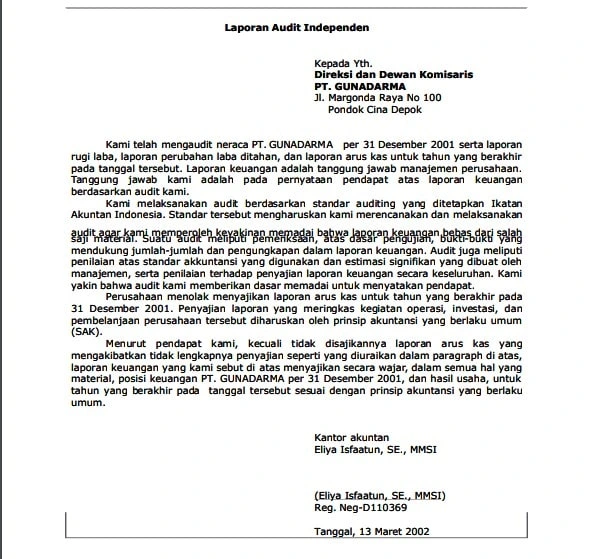
In that example, the auditor states the financial statements are fair except for a specific item whose presentation does not comply with the standard. The exception is confined to one item, while the other items still receive assurance of fairness.
Example 2 — Opinion Paragraph and Its Basis for Exception
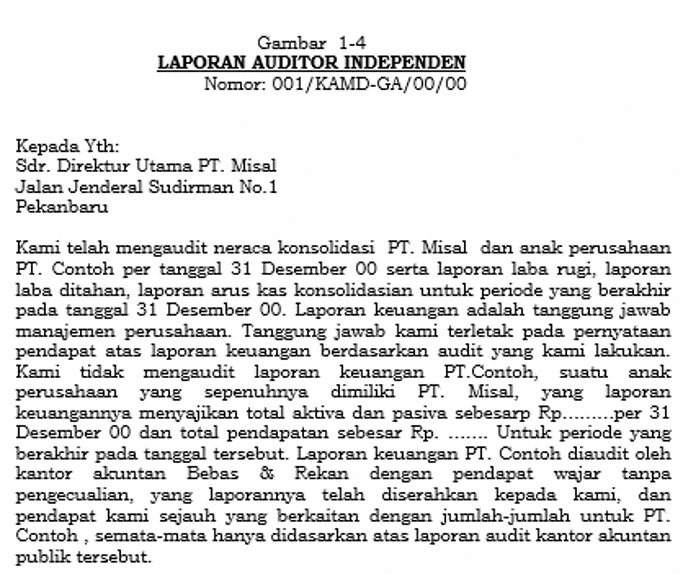
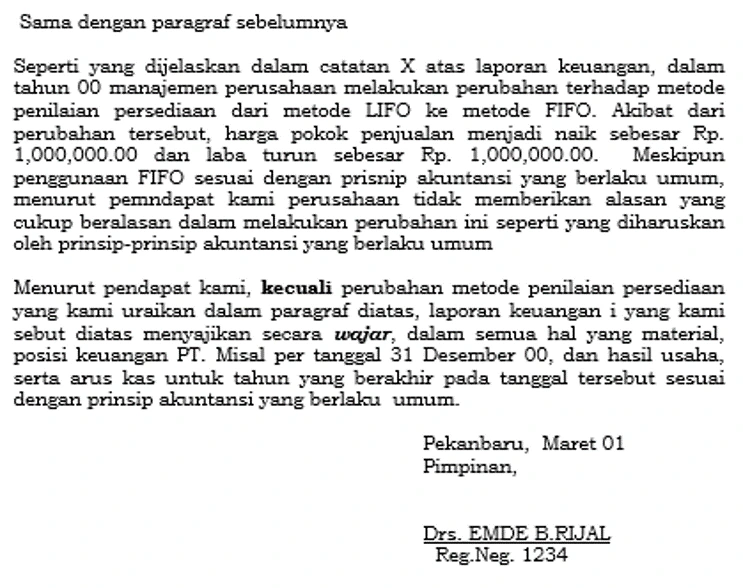
The second example shows that pair of paragraphs in full. The basis paragraph explains the nature of the deviation and the magnitude of its impact on the financial statement item, so readers can judge for themselves how far the exception affects their decision.
This is why the basis paragraph is important to read. Without reading it, a reader only knows there is an exception but not which item it concerns or how large it is.
What Are the Implications of a Qualified Opinion?
This opinion is not as severe as an adverse opinion, but it remains a warning that there is a specific aspect stakeholders need to pay attention to. Here is its impact.
1. Confidence of Stakeholders
Business partners and investors may question the quality of the company's reporting and financial management. Imperfections in the statements lower their confidence in financial management and internal oversight.
2. Relationship with creditors and investors
Creditors and investors become more cautious. Creditors may raise interest rates or request additional collateral, while investors see additional risk. The company can ease this with a transparent explanation accompanied by clear corrective steps.
3. Encourages Improvement of Internal Control
One of the main causes of this opinion is the weakness in internal control. This opinion pushes management to improve its control system, which not only reduces future risk but also improves long-term efficiency and accountability.
4. Company Reputation
This opinion can affect the company's reputation in the eyes of the public regarding the quality of its financial statements. That is why a company should respond proactively and take corrective steps promptly.

What Actions Can a Company Take?
1. Improving the Quality of Internal Control
Effective internal control reduces errors and irregularities in the financial statements. Its design must follow applicable standards and regulations so the resulting statements are accurate and trustworthy.
2. Ensuring Transparency of Information and Disclosure
During the audit process, the company must provide information openly without withholding relevant data or facts. Sufficient detail helps readers clearly assess the company's financial position and performance — while also preventing exceptions arising from inadequate disclosure.
3. Evaluating The Financial Reporting Process
An orderly reporting process makes it easier for the auditor to conduct the examination and reduces the risk of a scope limitation. Periodic evaluation of this process should be a standing agenda, not a reaction after receiving the opinion.
4. Strengthening Internal Audit as an Early Filter
Most causes of an exception can actually be found earlier by internal audit. Running compliance testing on a scheduled basis before the external audit gives the company time to fix problems while they can still be corrected.
Usage an audit software audit helps this process through:
- Automation and accurate recording — reducing manual errors so the data presented is more accurate.
- Continuous monitoring — running monitoring of the company's transactions and activities to detect non-conformities earlier.
- In-depth risk analysis — mapping which areas are most likely to give rise to an exception.
- Tracking of documentation and audit evidence — storing all documents on one platform so verification is faster and scope limitations can be avoided.
FAQ About Qualified Opinions
What is a qualified opinion?
A qualified opinion is the auditor's opinion stating that the financial statements are fairly presented, except for the effect of a specific matter that is excluded. On the excluded aspect the auditor gives a special note, while other items still receive assurance of fairness.
What does “exception” mean in an audit report?
An exception is the part of the financial statements pulled out of the fairness statement because the auditor found a problem there. In the opinion paragraph, that part appears after the phrase “except for”, and is explained in detail in the “Basis for Qualified Opinion” paragraph.
Qualified opinion what is it?
Qualified opinion is the English term for opini wajar dengan pengecualian. The word qualified means “subject to conditions” or “limited”, not “meets requirements”. Its opposite is an unqualified opinion, meaning an opinion without exception.
What is the basis for issuing a qualified opinion?
Three bases: a scope limitation on the audit when documents or access are unavailable, non-conformity with generally accepted accounting principles in part of the statements, and inadequate disclosure — as long as the impact is material but not pervasive.
How does it differ from an unqualified opinion?
An unqualified opinion is given when the auditor finds no material misstatement and obtains sufficient evidence. A qualified opinion is given when there is a material issue — either a misstatement or a limitation of evidence — but its impact is still confined to a specific item.
What is the difference from an adverse opinion?
Both can stem from a material misstatement, but they differ in how pervasive it is. A qualified opinion is given when the issue is confined to a specific item; an adverse opinion is given when the misstatement spreads so it affects the financial statements as a whole.
Can statements with this opinion still be used as a basis for decisions?
Still possible, with a caveat. Items outside the exception still receive assurance of fairness, so the statements can still be used as a basis for decisions as long as the reader takes into account the impact of the excluded matter as described in the basis paragraph.
What should the company do after receiving this opinion?
Improving the quality of internal control, ensuring transparency of information and disclosure during the audit, periodically evaluating the financial reporting process, and strengthening internal audit as an early filter before the external audit takes place.
See also — other types of audit opinion:
Prevent Exceptions Before the External Audit with Audithink
Scope limitations and inadequate disclosure — two of the three causes of an exception — are rooted in poorly organized documentation. Audithink, internal audit management software for companies and state-owned enterprises in Indonesia, helping internal audit teams run compliance testing on a scheduled basis, link every finding to its supporting evidence, and monitor corrective follow-up before the external auditor comes in.
See Audithink's features or schedule a demo to see how it works.
Consultation with the Audithink Team to discuss your company's internal audit needs.