

An adverse opinion (adverse opinion) is the auditor's statement that the financial statements contain a misstatement that is material and pervasive, so that overall they do not fairly present the company's financial condition.
This is the most severe opinion an auditor can issue. Unlike a qualified opinion, which only questions part of the statements, an adverse opinion states that the financial statements as a whole cannot be relied upon.
This article discusses the meaning of an adverse opinion, when it is given and how it differs from other opinions, its causes, example cases, its impact on the business, and how to avoid it.
What is unnatural opinion?
An adverse opinion is the auditor's statement indicating that the company's financial statements are presented incorrectly, contain inaccuracies, and do not reflect actual conditions. The auditor gives it when the financial statements deviate significantly from accounting generally applicable.
Literally, not fair means not presented as it should be. In an audit context, the word “fair” does not mean perfect or error-free, but that the financial statements are free of material misstatement. Only when the deviation has become so large that it affects the picture of the statements as a whole does the auditor state it is not fair.
An adverse opinion is issued by the external auditor or public accountant who audits the financial statements. Internal auditors do not issue this kind of opinion; their role is to give conclusions and recommendations on the effectiveness of the organization's controls, governance, and risk management.
Adverse Opinion are the Same Term
Adverse opinion is the English equivalent of opini tidak wajar, and this is the term used in international auditing standards. Some variations often encountered — opini adverse, adverse audit opinion, or audit report with an adverse — all refer to the same opinion.
When Is an Adverse Opinion Given?
The auditor does not choose an opinion based on preference. The determination follows two sequential questions: what is the issue, and how widespread is its impact.
- What is the issue? Did the auditor find a misstatement in the financial statements, or was the auditor instead unable to obtain sufficient evidence to assess it.
- How widespread is the impact? Is the issue material but confined to a specific item, or is it both material and pervasive — spreading so it affects the financial statements as a whole.
The combination of the two determines which opinion is issued:
| Nature of the issue | Material, not pervasive | Material and pervasive |
|---|---|---|
| The financial statements contain a misstatement | Qualified opinion | Adverse opinion |
| The auditor is unable to obtain sufficient evidence | Qualified opinion | Disclaimer of opinion |
Two important things stand out from that table. First, an adverse opinion arises only from a misstatement, not from a limitation of evidence. When the auditor is prevented from obtaining evidence to a pervasive degree, the appropriate opinion is a disclaimer of opinion, not an adverse opinion. Second, what distinguishes an adverse opinion from a qualified opinion is not merely the size of the figure, but how widespread its impact is on the statements.
See also: Audit Opinion: Meaning, Types, Stages, and Examples
Examples Of Unnatural Opinions
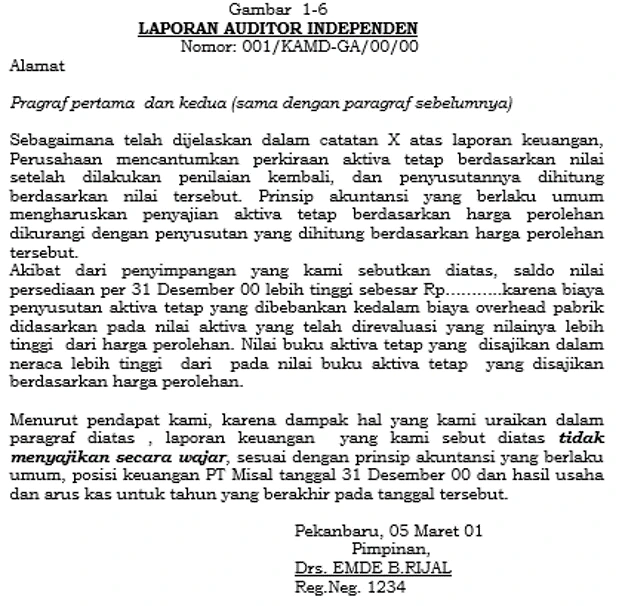
In that audit result, an adverse opinion was given because the company presented fixed assets based on a revaluation value instead of historical cost in accordance with generally accepted accounting principles.
In addition, depreciation expense was not properly recognized, causing the inventory balance as of December 31 to be higher than it should be. As a result, the financial statements did not reflect a fair and accurate financial position, so the auditor concluded that the statements were misstated.
Note that the deviation in this example touches both the basis for valuing the asset and its depreciation — not one isolated item. It is this pervasive nature that leads to an adverse opinion, rather than a mere qualification.
Here is an example of an unreasonable opinion in another audit.
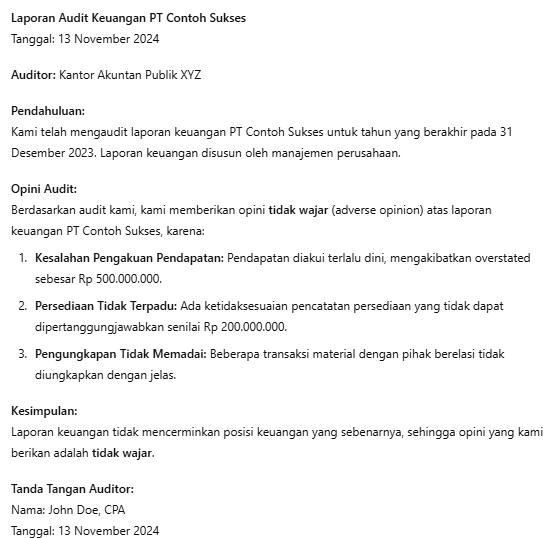
In the independent auditor's report, an adverse opinion is written in the opinion paragraph with a statement that the financial statements do not present fairly the entity's financial position — preceded by a “Basis for Adverse Opinion” paragraph that describes the deviation and the value of its impact.
What Causes an Adverse Opinion?
This opinion arises from a misstatement that is material and pervasive. Here are the most common underlying causes.
- Significant accounting errors. Errors in recording or recognizing transactions with a major impact, for example incorrectly recording revenue or expenses so the statements do not reflect actual conditions.
- Non-conformity with accounting standards. Use of a method that does not comply with PSAK or IFRS, so the presentation of the statements deviates from the applicable standard rules.
- Non-compliance with regulations. Violation of tax rules, trade law, or industry regulations that has a significant impact on the figures in the financial statements.
- Fraud or fraud. Deliberate manipulation of financial data by management or employees, for example inflating asset values or hiding liabilities so the statements are distorted.
- Management's refusal to correct a misstatement. The auditor finds a material misstatement and communicates it, but management refuses to make the adjustment.
Important notes: a scope limitation on the audit — when the auditor is not given full access to information — does not result in an adverse opinion. That condition, including the inability to obtain evidence, leads to a qualified opinion or a disclaimer of opinion, depending on how pervasive it is.
What Is the Impact of an Adverse Opinion on Business?

Beyond stakeholder confidence, this opinion carries the following negative impacts for the business.
1. Declining Investor Trust
An adverse opinion signals that some financial aspect does not conform to accounting standards. Investors may conclude there are serious problems in financial management, so they withdraw their investment or hesitate to add funds.
2. Affected Company Reputation
A tarnished reputation makes it harder for the company to form partnerships. Prospective partners or customers tend to choose to work with competitors seen as more reliable.
3. Limited access to financing
Banks and financial institutions read the financial statements as an indicator of business health. With an adverse opinion, they may offer much stricter loan terms or reject financing applications altogether.
4. Difficulty in the Acquisition Process or Merger
For companies in the process merger or acquisition, an adverse opinion becomes a major obstacle. Prospective buyers will conduct much stricter due diligence, which can slow down or even cancel the deal.
5. Possibility Of Legal Cases
If the adverse opinion is rooted in an intentional deviation, the company may face legal problems, since such practices can violate applicable financial and tax laws.

How Can an Adverse Opinion Be Avoided?
- Ensuring accurate accounting records. Record revenue, expenses, and assets accurately so the financial statements reflect actual conditions.
- Following applicable accounting standards. Apply accounting methods in accordance with PSAK or IFRS so the presentation of the statements does not deviate from the standard rules.
- Giving the auditor full access. Ensure the auditor obtains all the information and documents needed to thoroughly verify the financial data.
- Complying with relevant laws and regulations. Comply with tax rules, trade law, and industry regulations that affect the financial statements.
- Preventing fraud and data manipulation. Strengthen internal control to prevent fraud that undermines the reliability of the financial statements.
- Correcting errors before the audit is complete. If the auditor communicates a misstatement, make the adjustment immediately. A misstatement that has been corrected no longer affects the opinion.
- Conducting periodic internal audits. Run internal audit routinely to test compliance with accounting standards and data integrity before the external audit takes place.
With these steps, a company can lower the risk of receiving an adverse opinion while maintaining stakeholder confidence.
FAQ About Adverse Opinions
What is an adverse opinion?
An adverse opinion or adverse opinion is the auditor's statement that the financial statements contain a misstatement that is material and pervasive, so that overall they do not fairly present the company's financial condition.
Adverse opinion what is it?
Adverse opinion is the English term for opini tidak wajar, an opinion stating that the financial statements are not fairly presented because of a misstatement that is material and pervasive. This term is also often called an adverse.
What does “not fair” mean in audit?
In audit, “fair” means the financial statements are free of material misstatement — it does not mean perfect. So “not fair” means the deviation has become so large and widespread that it affects the picture of the financial statements as a whole.
What is the difference between an adverse opinion and a qualified opinion?
Both stem from a material misstatement, but they differ in how pervasive it is. A qualified opinion is given when the misstatement is confined to a specific item, while an adverse opinion is given when the misstatement spreads and affects the financial statements as a whole.
Does a scope limitation result in an adverse opinion?
No. A scope limitation, including the auditor's inability to obtain evidence, leads to a qualified opinion or a disclaimer of opinion. An adverse opinion only arises from a misstatement in the financial statements.
Who issues an adverse opinion?
The external auditor or public accountant who audits the financial statements. Internal auditors do not issue opinions on financial statements; their role is to give conclusions and recommendations on the effectiveness of controls, governance, and risk management.
What causes an adverse opinion?
Significant accounting errors, non-conformity with PSAK or IFRS, non-compliance with regulations that affects the reported figures, fraud or data manipulation, and management's refusal to correct a misstatement already communicated by the auditor.
What is the impact of an adverse opinion on a business?
Five impacts: declining investor confidence, reputation affected among partners and customers, limited financing access as banks tighten loan terms, the merger or acquisition is hampered, and the possibility of facing legal cases if the deviation was intentional.
See also — other types of audit opinion:
Prevent Misstatements Before the External Audit with Audithink
An adverse opinion almost always starts from a problem that could actually have been caught earlier by internal audit. Audithink, internal audit management software for companies and state-owned enterprises in Indonesia, helping internal audit teams test compliance on a scheduled basis, document findings along with their evidence, and monitor corrective follow-up before the external auditor comes in.
See Audithink's features or schedule a demo to see how it works.
Consultation with the Audithink Team to discuss your company's internal audit needs.